


As a supplier of XRF (X-ray Fluorescence) gold testing equipment, I've witnessed firsthand the remarkable capabilities of this technology in the precious metals industry. XRF testing offers a non-destructive, rapid, and relatively accurate method for analyzing the composition of gold and other metals. However, like any analytical technique, it has its limitations. Understanding these limitations is crucial for both users of XRF gold testers and those considering investing in this technology.
Surface Sensitivity
One of the primary limitations of XRF testing for gold is its surface sensitivity. XRF analyzers measure the X-ray fluorescence emitted from the surface layer of the sample, typically within a few micrometers. This means that the results are representative only of the surface composition and may not accurately reflect the bulk composition of the sample.
For example, in gold-plated items, the XRF analyzer will detect the composition of the gold plating rather than the underlying metal. This can lead to inaccurate results if the user assumes that the surface composition is the same throughout the entire item. Similarly, in gold alloys with a heterogeneous distribution of elements, the surface may have a different composition than the interior, resulting in misleading test results.
To mitigate this limitation, it's important to take multiple measurements from different locations on the sample surface and, if possible, to perform a destructive analysis (such as acid testing or fire assay) to confirm the bulk composition.
Limited Depth of Analysis
In addition to surface sensitivity, XRF testing has a limited depth of analysis. The penetration depth of X-rays into the sample depends on the energy of the X-rays and the density and composition of the sample. In general, the penetration depth is on the order of a few micrometers to a few millimeters.
This limited depth of analysis can be a problem when testing thick gold items or items with complex internal structures. For example, in a gold bar with a core of a different metal, the XRF analyzer may not be able to detect the presence of the core if it is located deeper than the penetration depth of the X-rays. Similarly, in gold jewelry with intricate designs or hidden compartments, the XRF analyzer may not be able to accurately measure the composition of all parts of the item.
To overcome this limitation, it may be necessary to use other analytical techniques in conjunction with XRF testing, such as cross-sectional analysis or tomography.
Interference from Other Elements
Another limitation of XRF testing for gold is the potential for interference from other elements. XRF analyzers work by measuring the characteristic X-ray fluorescence emitted by different elements in the sample. However, some elements may emit X-rays at similar energies, which can interfere with the accurate measurement of the gold content.
For example, copper and zinc are common alloying elements in gold alloys, and their X-ray fluorescence spectra can overlap with that of gold. This can make it difficult to accurately measure the gold content in samples containing high levels of copper or zinc. Similarly, other elements such as iron, nickel, and lead can also interfere with the XRF measurement of gold.
To minimize the effects of interference, XRF analyzers are typically calibrated using a set of standards with known compositions. However, even with calibration, there may still be some residual interference, especially in samples with complex compositions. In such cases, it may be necessary to use more advanced analytical techniques, such as inductively coupled plasma mass spectrometry (ICP-MS), to accurately measure the gold content.
Accuracy and Precision
The accuracy and precision of XRF testing for gold depend on several factors, including the quality of the analyzer, the calibration standards used, and the operator's skill and experience. While XRF analyzers can provide relatively accurate results for gold alloys within a certain range of compositions, there is always some degree of uncertainty associated with the measurements.
The accuracy of XRF testing is typically expressed as the difference between the measured value and the true value of the gold content. The precision of XRF testing is typically expressed as the standard deviation of multiple measurements taken on the same sample. In general, the accuracy and precision of XRF testing are better for samples with simple compositions and homogeneous distributions of elements.
To ensure the accuracy and precision of XRF testing, it's important to use a high-quality analyzer that has been properly calibrated and maintained. It's also important to follow the manufacturer's instructions for sample preparation and analysis and to take multiple measurements to reduce the effects of random errors.
Sample Size and Shape
The size and shape of the sample can also affect the accuracy and reliability of XRF testing for gold. XRF analyzers are designed to analyze samples of a certain size and shape, and samples that are too small or too large may not be analyzed accurately.
For example, in small samples, the XRF analyzer may not be able to collect enough X-ray fluorescence signal to accurately measure the gold content. Similarly, in large samples, the XRF analyzer may not be able to cover the entire sample surface, resulting in incomplete analysis. In addition, the shape of the sample can also affect the X-ray fluorescence signal, especially if the sample has a curved or irregular surface.
To ensure accurate and reliable XRF testing, it's important to choose a sample size and shape that is appropriate for the analyzer and to prepare the sample surface as flat and smooth as possible.
Cost and Complexity
Finally, it's important to consider the cost and complexity of XRF testing for gold. XRF analyzers can be expensive, especially high-end models with advanced features and capabilities. In addition, the cost of calibration standards, consumables, and maintenance can also add up over time.

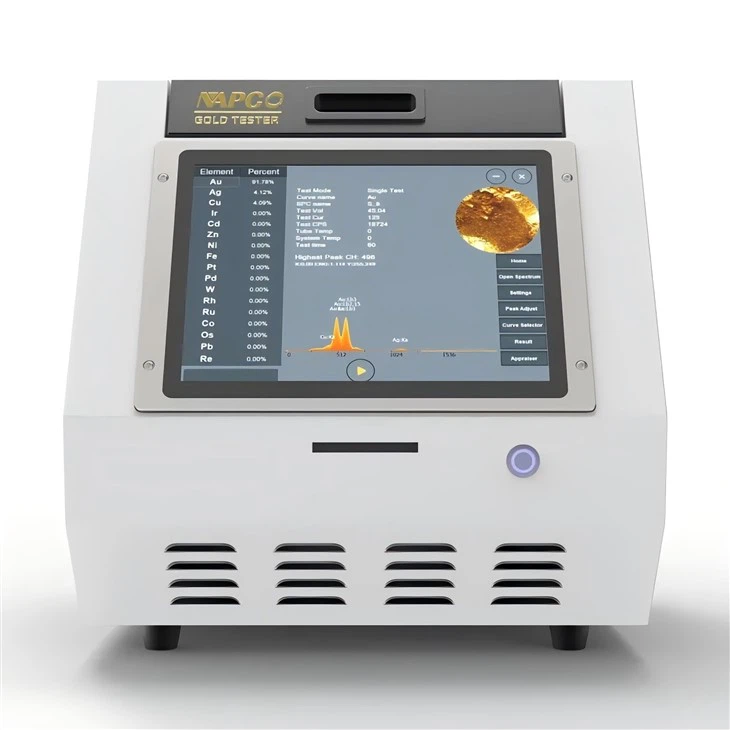
Furthermore, XRF testing requires some level of technical expertise and training to operate the analyzer and interpret the results. This can be a barrier for some users, especially those with limited resources or experience in analytical chemistry.
Despite these limitations, XRF testing remains a valuable tool for the analysis of gold and other precious metals. It offers a non-destructive, rapid, and relatively accurate method for screening samples and determining their approximate composition. However, it's important to be aware of the limitations of XRF testing and to use it in conjunction with other analytical techniques when necessary to ensure accurate and reliable results.
Our XRF Gold Testers
At our company, we offer a range of high-quality XRF gold testers, including the N1 XRF Gold Tester, the NAP 8200E XRF Gold Tester, and the NA 8500 XRF Gold Tester. These testers are designed to provide accurate and reliable results for a wide range of gold samples, and they are easy to use and maintain.
If you're interested in learning more about our XRF gold testers or have any questions about XRF testing for gold, please don't hesitate to contact us. We'd be happy to discuss your specific needs and help you choose the right analyzer for your application.
References
- Jenkins, R., Gould, R. W., & Gedcke, D. (1981). Quantitative X-ray fluorescence analysis. Marcel Dekker.
- Van Grieken, R., & Markowicz, A. A. (2002). Handbook of X-ray spectrometry. Marcel Dekker.
- Potts, P. J., & Webb, P. C. (2009). X-ray fluorescence spectrometry: A practical guide. Cambridge University Press.