


Radiation is a topic that often raises concerns, especially when it comes to devices used in various industries, such as XRF gold testers. As a supplier of XRF gold testers, I understand the importance of addressing the question: What is the radiation level of an XRF gold tester? In this blog, we will explore the science behind XRF technology, the typical radiation levels of our XRF gold testers, and how we ensure safety in our products.
Understanding XRF Technology
XRF, or X-ray fluorescence, is a non-destructive analytical technique used to determine the elemental composition of a sample. In the context of gold testing, XRF gold testers emit X-rays onto the sample. These X-rays interact with the atoms in the gold and other metals present in the sample, causing the atoms to emit secondary X-rays, known as fluorescent X-rays. By measuring the energy and intensity of these fluorescent X-rays, the XRF gold tester can identify and quantify the elements in the sample, including gold, silver, platinum, and other precious metals.
Radiation Sources in XRF Gold Testers
XRF gold testers typically use either an X-ray tube or a radioactive isotope as the source of X-rays. X-ray tubes are the most common type of radiation source in modern XRF gold testers. They work by accelerating electrons towards a target material, which then emits X-rays. The advantage of X-ray tubes is that they can be turned on and off, allowing for better control of the radiation exposure.
Radioactive isotopes, on the other hand, emit X-rays continuously. While they were more commonly used in the past, their use has declined due to the associated safety and regulatory challenges. However, some older XRF gold testers may still use radioactive isotopes as the radiation source.
Radiation Levels of Our XRF Gold Testers
At our company, we are committed to providing our customers with safe and reliable XRF gold testers. Our XRF gold testers are designed to meet or exceed all relevant safety standards and regulations.
The N1-10 XRF Gold Tester is one of our popular models. It uses an X-ray tube as the radiation source, which allows for precise control of the radiation output. The radiation levels emitted by the N1-10 are well within the limits set by international safety standards. During normal operation, the radiation exposure at a distance of 5 cm from the sample chamber is typically less than 1 μSv/h (microsievert per hour). This is a very low level of radiation, equivalent to the natural background radiation that we are exposed to every day.
Another model in our product line is the N1-25 XRF Gold Tester. Similar to the N1-10, it also uses an X-ray tube and has a low radiation output. The radiation levels of the N1-25 are carefully monitored and controlled during the manufacturing process to ensure compliance with safety regulations. The typical radiation exposure at a distance of 5 cm from the sample chamber is also less than 1 μSv/h.
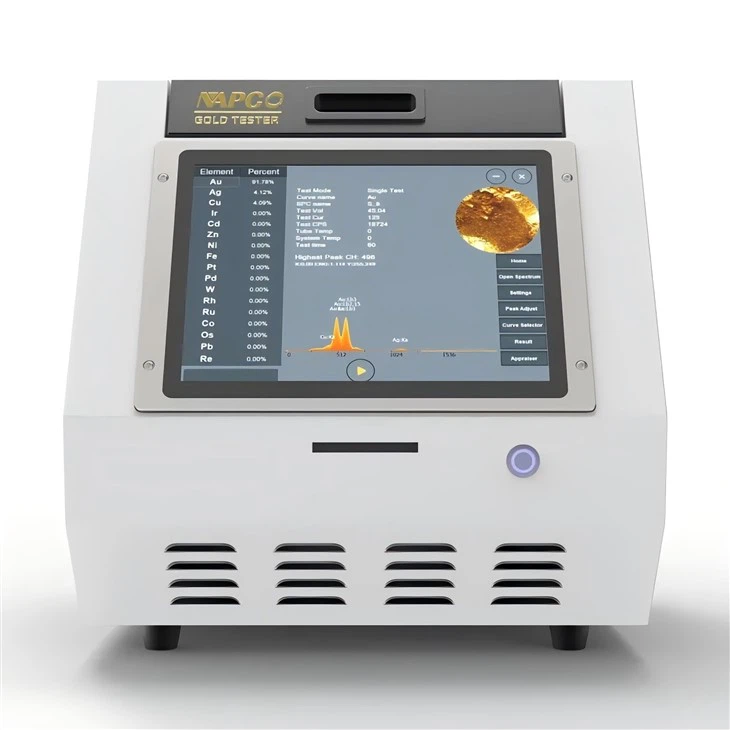

The NAP 8200E XRF Gold Tester is a high-performance XRF gold tester that offers advanced features and accurate results. It too uses an X-ray tube and has a radiation output that is well below the safety limits. The radiation exposure at a distance of 5 cm from the sample chamber is typically less than 1 μSv/h, ensuring the safety of the operators.
Safety Features of Our XRF Gold Testers
In addition to having low radiation levels, our XRF gold testers are equipped with a number of safety features to further protect the operators. These safety features include:
- Interlock systems: All of our XRF gold testers are equipped with interlock systems that automatically shut off the X-ray source when the sample chamber door is opened. This prevents accidental exposure to radiation.
- Radiation shielding: The XRF gold testers are designed with radiation shielding to minimize the radiation leakage outside the instrument. The shielding materials are carefully selected and engineered to provide effective protection.
- Safety indicators: The instruments are equipped with safety indicators that show the status of the X-ray source, such as whether it is on or off. This allows the operators to easily monitor the safety of the instrument.
- Training and support: We provide comprehensive training and support to our customers to ensure that they understand how to use the XRF gold testers safely. Our training programs cover topics such as radiation safety, instrument operation, and maintenance.
Regulatory Compliance
Our XRF gold testers are designed and manufactured in compliance with all relevant international safety standards and regulations, such as ISO 15597, ASTM E1621, and IEC 61557. These standards ensure that the instruments are safe to use and that the radiation levels are within acceptable limits.
We also work closely with regulatory authorities to ensure that our products meet the specific requirements of different countries and regions. This includes obtaining the necessary certifications and approvals, such as CE certification for the European market.
Conclusion
In conclusion, the radiation levels of our XRF gold testers are very low and well within the limits set by international safety standards. Our XRF gold testers use X-ray tubes as the radiation source, which allows for precise control of the radiation output. In addition, our instruments are equipped with a number of safety features to further protect the operators.
If you are in the market for an XRF gold tester, we invite you to contact us to learn more about our products and how they can meet your needs. Our team of experts is available to answer any questions you may have and to assist you in choosing the right XRF gold tester for your application.
References
- ISO 15597:2006 - Petroleum and related products - Determination of elements content by wavelength dispersive X-ray fluorescence spectrometry - Part 1: Determination of sulfur
- ASTM E1621 - Standard Test Method for Elemental Analysis by Wavelength - Dispersive X - ray Fluorescence Spectrometry
- IEC 61557 - Electrical safety in low - voltage distribution systems up to 1 000 V a.c. and 1 500 V d.c. - Equipment for testing, measuring or monitoring of protective measures