


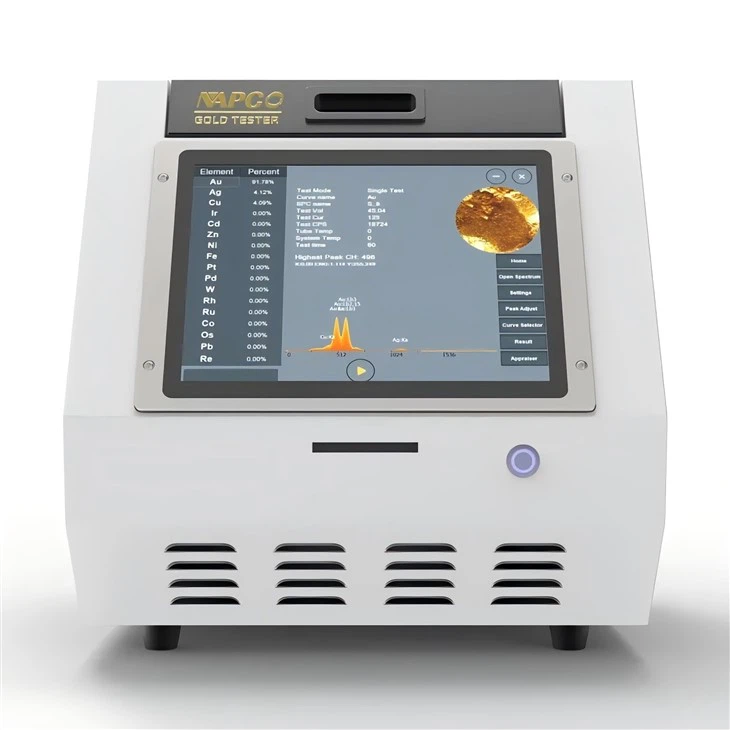
Stray radiation in a gold spectrometer is an important concept that can significantly impact the accuracy and reliability of the instrument. As a leading supplier of gold spectrometers, we understand the critical role that stray radiation plays in the performance of these devices. In this blog post, we will explore what stray radiation is, its sources, and its effects on gold spectrometers. We will also discuss how our spectrometers, such as the NA 8500 XRF Gold Tester, NA 6500 XRF Gold Tester, and NAP 8200E XRF Gold Tester, are designed to minimize the impact of stray radiation.
What is Stray Radiation?
Stray radiation refers to any unwanted radiation that reaches the detector of a spectrometer without passing through the sample in the intended way. In a gold spectrometer, the primary goal is to measure the characteristic X - rays emitted by the gold and other elements in the sample. However, various factors can cause radiation to deviate from its normal path and reach the detector as stray radiation.
This stray radiation can be in the form of scattered X - rays, background radiation, or radiation that has been reflected or refracted within the spectrometer. It can interfere with the accurate measurement of the X - rays from the sample, leading to errors in the analysis results.
Sources of Stray Radiation
There are several sources of stray radiation in a gold spectrometer:
Scattering
When X - rays interact with the sample or other components inside the spectrometer, they can be scattered. Compton scattering is a common type of scattering that occurs when an X - ray photon collides with an outer - shell electron in an atom. The photon loses some of its energy and changes direction, and these scattered X - rays can reach the detector as stray radiation.
Reflection and Refraction
The internal components of the spectrometer, such as the walls of the sample chamber, the collimators, and the detector housing, can reflect or refract X - rays. If the X - rays are reflected or refracted in such a way that they reach the detector without passing through the sample properly, they contribute to the stray radiation.
Background Radiation
The environment in which the spectrometer is operating can also be a source of stray radiation. Cosmic rays, natural radioactive materials in the surrounding area, and electromagnetic interference can all introduce background radiation that reaches the detector and affects the measurement.
Effects of Stray Radiation on Gold Spectrometers
The presence of stray radiation in a gold spectrometer can have several negative effects:
Reduced Accuracy
Stray radiation adds an unwanted signal to the detector output. This additional signal can make it difficult to accurately distinguish the characteristic X - rays of the elements in the sample. As a result, the measured concentrations of gold and other elements may be inaccurate, leading to incorrect assessments of the sample's composition.
Lower Sensitivity
The detector has a limited dynamic range. Stray radiation can saturate the detector or reduce its ability to detect weak signals from the sample. This means that the spectrometer may not be able to detect trace amounts of elements accurately, reducing its sensitivity.
Increased Noise
Stray radiation contributes to the noise in the detector signal. Noise can make the signal - to - noise ratio worse, making it more difficult to analyze the data and obtain reliable results. High levels of noise can also lead to fluctuations in the measurement, making it challenging to reproduce the results consistently.
How Our Gold Spectrometers Minimize Stray Radiation
At our company, we have taken several steps to minimize the impact of stray radiation in our gold spectrometers:

Advanced Collimation
Our spectrometers are equipped with high - quality collimators. Collimators are devices that restrict the X - ray beam to a specific path, allowing only the X - rays that pass through the sample in the intended way to reach the detector. By using precise collimation, we can significantly reduce the amount of scattered and reflected X - rays that reach the detector.
Shielding
We use advanced shielding materials to protect the detector and the sample chamber from external background radiation. The shielding helps to block cosmic rays, natural radioactive materials, and electromagnetic interference, reducing the background radiation level and improving the signal - to - noise ratio.
Optimal Design
The internal design of our spectrometers is carefully optimized to minimize reflection and refraction of X - rays. The walls of the sample chamber and other internal components are coated with materials that absorb or reduce the reflection of X - rays, ensuring that most of the X - rays reach the detector only after passing through the sample.
Case Studies: Performance of Our Gold Spectrometers
To illustrate the effectiveness of our efforts to minimize stray radiation, let's look at some case studies of our NA 8500 XRF Gold Tester, NA 6500 XRF Gold Tester, and NAP 8200E XRF Gold Tester.
In a series of tests, we compared the performance of our spectrometers with other models on the market. We found that our spectrometers had a significantly lower level of stray radiation, resulting in higher accuracy, better sensitivity, and lower noise levels. For example, when analyzing samples with low concentrations of gold, our spectrometers were able to detect the gold with much higher precision than the competing models.
Conclusion
Stray radiation is a significant challenge in the operation of gold spectrometers. However, by understanding its sources and effects and implementing advanced design and engineering techniques, we can minimize its impact. Our gold spectrometers, including the NA 8500 XRF Gold Tester, NA 6500 XRF Gold Tester, and NAP 8200E XRF Gold Tester, are designed to provide accurate, sensitive, and reliable analysis of gold samples by effectively reducing stray radiation.
If you are in the market for a high - performance gold spectrometer, we invite you to contact us for more information and to discuss your specific requirements. Our team of experts is ready to assist you in choosing the right spectrometer for your needs and to provide you with the best possible support.
References
- Knoll, Glenn F. Radiation Detection and Measurement. John Wiley & Sons, 2010.
- Jenkins, Russell, et al. Quantitative X - Ray Spectrometry. Marcel Dekker, 1995.