


Heat treatment is a common practice in the gold industry, used to enhance certain properties of gold such as hardness, malleability, and color. However, it can also pose challenges when it comes to accurately determining the purity of gold. As a leading supplier of gold purity testers, we understand the intricacies involved in dealing with heat - treated gold and are committed to providing solutions that ensure precise and reliable results.
The Impact of Heat Treatment on Gold
Heat treatment can cause several changes in the physical and chemical properties of gold. When gold is heated, it may undergo phase transformations, alloying element redistribution, and surface oxidation. These changes can affect the way gold interacts with the testing methods employed by gold purity testers.
For instance, during heat treatment, some alloying elements in gold alloys may diffuse to the surface or form new compounds. This can lead to a non - uniform distribution of elements within the gold sample, making it more difficult to obtain an accurate representation of the overall purity. Additionally, surface oxidation can create a layer that may interfere with the testing process, especially for methods that rely on surface analysis.
Traditional Testing Methods and Their Limitations
Traditional methods for testing gold purity, such as acid testing and fire assay, have been used for centuries. Acid testing involves applying nitric acid or other acids to the gold sample to observe the reaction. However, heat - treated gold may react differently due to the changes in its surface and internal structure. The presence of surface oxides or altered alloy compositions can lead to false readings, making it unreliable for accurately determining the purity of heat - treated gold.
Fire assay, on the other hand, is a more accurate but destructive method. It involves melting the gold sample with fluxes and then separating the precious metals from the impurities. While it can provide highly accurate results, it is time - consuming, expensive, and destroys the sample. For heat - treated gold, the high - temperature melting process may further change the composition of the sample, especially if there are volatile alloying elements present.
Modern XRF Technology: A Solution for Heat - Treated Gold
X - Ray Fluorescence (XRF) technology has emerged as a powerful tool for testing the purity of gold, especially for heat - treated samples. XRF gold testers work by irradiating the gold sample with X - rays. The atoms in the gold and its alloying elements absorb the X - rays and then emit characteristic fluorescent X - rays. By analyzing the energy and intensity of these fluorescent X - rays, the tester can determine the elemental composition and thus the purity of the gold.
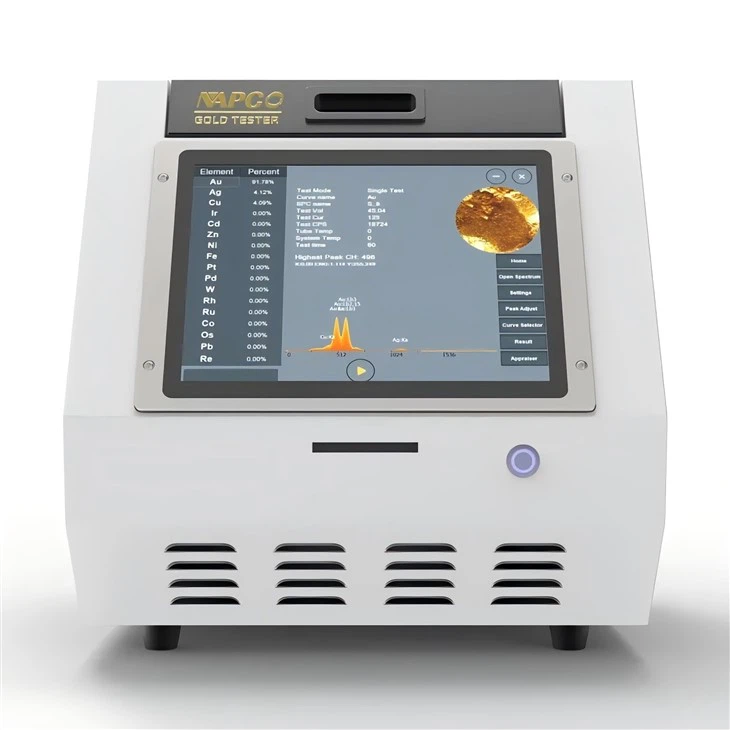
One of the key advantages of XRF technology is its non - destructive nature. It allows for quick and accurate testing without damaging the sample, which is particularly important for valuable heat - treated gold items. Our NAP 8200E XRF Gold Tester is equipped with advanced XRF technology that can penetrate through the surface layer of heat - treated gold to analyze the underlying composition. It uses a high - energy X - ray source and a sensitive detector to ensure accurate and reliable results, even for samples with complex alloy compositions.
Another advantage of XRF technology is its ability to provide real - time results. Unlike traditional methods that may take hours or even days to complete, an XRF gold tester can provide results within seconds or minutes. This makes it ideal for high - volume testing in jewelry manufacturing, gold trading, and pawn shops. Our NA 6500 XRF Gold Tester offers fast and accurate testing, allowing users to quickly determine the purity of heat - treated gold samples and make informed decisions.
Calibration and Standardization for Heat - Treated Gold
To ensure the accuracy of XRF gold testers when dealing with heat - treated gold, proper calibration and standardization are crucial. Calibration involves adjusting the tester to match the known values of standard gold samples. For heat - treated gold, it is important to use standard samples that have undergone similar heat treatment processes. This helps to account for any changes in the elemental distribution and surface properties caused by heat treatment.
Our N1 XRF Gold Tester comes with a comprehensive calibration system that can be customized for different types of heat - treated gold samples. It allows users to input specific calibration parameters based on the heat treatment conditions, such as temperature, time, and atmosphere. This ensures that the tester provides accurate results for a wide range of heat - treated gold samples, regardless of their complexity.
Surface Preparation for Heat - Treated Gold Testing
Proper surface preparation is also essential for accurate testing of heat - treated gold. The surface of heat - treated gold may be covered with oxides, scale, or other contaminants that can interfere with the XRF testing process. To ensure reliable results, the surface of the sample should be cleaned and polished to remove any surface layers.
However, it is important to note that excessive polishing can also remove some of the surface alloying elements, leading to inaccurate results. Therefore, a gentle cleaning and polishing method should be used. For example, using a soft abrasive cloth or a mild chemical cleaner can effectively remove surface contaminants without altering the underlying alloy composition.
Quality Control and Assurance
As a gold purity tester supplier, we are committed to providing high - quality products that meet the strictest industry standards. Our XRF gold testers undergo rigorous quality control and assurance procedures to ensure their accuracy and reliability. We use advanced manufacturing techniques and high - quality components to ensure the long - term performance of our testers.
In addition, we provide comprehensive after - sales support, including technical training, calibration services, and maintenance. Our team of experts is available to assist customers with any questions or issues they may encounter when testing heat - treated gold. We also offer regular software updates to ensure that our testers are always up - to - date with the latest testing algorithms and calibration parameters.
Conclusion
Heat - treated gold presents unique challenges when it comes to determining its purity. Traditional testing methods may not be sufficient due to the changes in the physical and chemical properties of heat - treated gold. However, modern XRF technology offers a reliable and non - destructive solution for accurately testing the purity of heat - treated gold.
Our range of XRF gold testers, including the NAP 8200E XRF Gold Tester, NA 6500 XRF Gold Tester, and N1 XRF Gold Tester, are designed to overcome these challenges and provide accurate results for heat - treated gold samples. With proper calibration, surface preparation, and quality control, our testers can help you make informed decisions when dealing with heat - treated gold.

If you are in the market for a reliable gold purity tester to deal with heat - treated gold, we invite you to contact us for more information. Our team of experts is ready to assist you in choosing the right tester for your specific needs and to provide you with the best possible support.
References
- "Gold Metallurgy and Refining" by Peter D. Roach
- "X - Ray Fluorescence Spectrometry: Principles and Applications" by Ronald Jenkins
- Industry reports on gold testing and heat treatment processes.