


Hey there! As a supplier of gold XRF machines, I often get asked about the signal-to-noise ratio of these devices. So, let's dive right in and break down what this term means and why it's super important when it comes to gold XRF machines.
First off, what's the signal-to-noise ratio (SNR) anyway? Well, in simple terms, the SNR is a measure that compares the level of a desired signal (the information we're interested in) to the level of background noise. In the context of a gold XRF machine, the signal is the X-ray fluorescence data that tells us about the elemental composition of the gold sample, like how much pure gold is in there, and what other elements might be mixed in. The noise, on the other hand, is all the unwanted random signals that can interfere with our ability to accurately measure the elements in the sample.
Imagine you're trying to listen to a friend talking at a noisy party. The friend's voice is the signal, and all the background chatter, music, and clinking glasses are the noise. If the noise is too loud, it's hard to hear what your friend is saying. Similarly, in a gold XRF machine, a low SNR means that the noise can drown out the useful signal, making it difficult to get accurate and reliable results.
So, why does the SNR matter so much for gold XRF machines? When you're dealing with precious metals like gold, even a small error in measurement can have a big impact on the value of the sample. For example, if you're a jeweler trying to determine the karat of a gold piece, an inaccurate measurement could lead to overpaying or underpaying for the item. A high SNR ensures that the machine can detect even trace amounts of elements in the gold sample with high precision. This is crucial for applications like quality control in the jewelry industry, assaying of gold bullion, and recycling of precious metals.
Now, let's talk about how the SNR affects the performance of our gold XRF machines. A higher SNR generally means faster analysis times. When the signal is strong relative to the noise, the machine can quickly and accurately identify the elements in the sample. This is great for businesses that need to process a large number of samples in a short amount of time. For instance, a gold refinery might have hundreds of samples to test each day. A machine with a high SNR can get the job done more efficiently, saving time and money.
Another benefit of a high SNR is better sensitivity. It allows the machine to detect very low concentrations of elements in the gold. This is important because sometimes, gold samples can contain small amounts of impurities or alloying elements that can affect the quality and value of the gold. With a high SNR, our NAP 8200E XRF Gold Tester can pick up these subtle differences, giving you a more comprehensive analysis of the sample.
At our company, we've put a lot of effort into optimizing the SNR of our gold XRF machines. We use advanced detector technology and signal processing algorithms to reduce noise and enhance the signal. Our N1 - 25 XRF Gold Tester is a great example. It's equipped with state-of-the-art detectors that can capture a large amount of the X-ray fluorescence signal while minimizing the background noise. This results in a high SNR and extremely accurate measurements.
Similarly, our N1 - 10 XRF Gold Tester is designed with a focus on improving the SNR. We've fine-tuned the hardware and software to ensure that the machine can provide reliable results even in challenging environments. Whether you're working in a busy jewelry workshop or a high - tech laboratory, this machine can deliver consistent performance.
But how do we measure the SNR of our gold XRF machines? There are several methods, but one common approach is to use a test sample with a known elemental composition. We run the sample through the machine multiple times and analyze the data to calculate the ratio of the signal strength to the noise level. This allows us to quantify the SNR and make adjustments to the machine's settings if necessary.
In addition to the hardware and software design, factors like the X-ray source, the detector's cooling system, and the shielding of the machine can also affect the SNR. For example, a well - shielded machine can reduce the amount of external radiation that can contribute to the noise. And a properly cooled detector can operate more efficiently, resulting in a higher SNR.
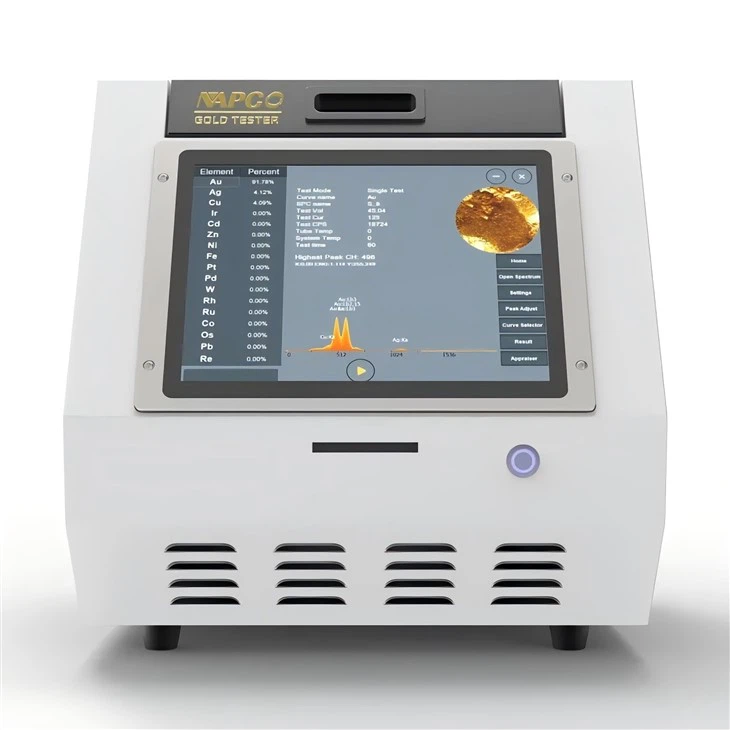

When you're in the market for a gold XRF machine, it's important to consider the SNR as one of the key factors. A machine with a high SNR will give you more accurate results, faster analysis times, and better overall performance. Don't just focus on the price or the brand name. Look at the technical specifications and ask the supplier about the SNR of the machine.
If you're interested in learning more about our gold XRF machines and how their high SNR can benefit your business, we'd love to hear from you. Whether you're a small - scale jeweler, a large - scale refinery, or a research institution, our machines are designed to meet your needs. We can provide you with detailed information, product demonstrations, and even customized solutions based on your specific requirements.
So, if you're ready to take your gold analysis to the next level, get in touch with us. Let's start a conversation about how our gold XRF machines can help you achieve more accurate and reliable results.
References
- "X-ray Fluorescence Spectrometry: Principles and Applications" by E. P. Bertin
- "Handbook of X-ray Spectrometry" by V. A. Fassel and H. E. Malmstadt