




Hey there! As a supplier of gold testing machines, I often get asked about the detection limit of these nifty devices. So, I thought I'd take some time to break it down for you in a way that's easy to understand.
First things first, what exactly do we mean by the "detection limit" of a gold testing machine? Well, simply put, it's the lowest amount of gold that the machine can accurately detect and measure. This is a crucial factor because it determines how sensitive the machine is and how reliable its results are, especially when dealing with small or trace amounts of gold.
There are a few different types of gold testing machines out there, but the ones we'll focus on today are XRF (X-ray fluorescence) gold testers. These are some of the most popular and widely used machines in the industry, and for good reason. They're non-destructive, which means they don't damage the sample being tested, and they can provide quick and accurate results.
Let's start by talking about the factors that can affect the detection limit of an XRF gold tester. One of the most important factors is the type of X-ray tube used in the machine. Different X-ray tubes have different energy levels, and higher energy tubes can generally detect lower levels of gold. This is because higher energy X-rays can penetrate deeper into the sample and interact with more atoms, making it easier to detect even small amounts of gold.
Another factor is the detector used in the machine. The detector is responsible for measuring the X-rays that are emitted by the sample after it's been irradiated with X-rays. A more sensitive detector can pick up on smaller signals, which means it can detect lower levels of gold.
The design and construction of the machine also play a role in its detection limit. For example, a machine with a well-shielded X-ray source and detector can reduce background noise and interference, which can improve the accuracy of the measurements. Additionally, the software used to analyze the data from the machine can also affect its performance. A more advanced software algorithm can help to identify and quantify even the smallest amounts of gold in the sample.
Now, let's take a look at some of the specific models of XRF gold testers that we offer and their detection limits.
The N1-10 XRF Gold Tester is a great option for those who need a reliable and affordable gold testing machine. It has a detection limit of around 0.1% for gold, which means it can accurately detect and measure gold content as low as 0.1%. This makes it suitable for a wide range of applications, from testing jewelry to analyzing gold ore samples.
The NAP 8200E XRF Gold Tester is a more advanced model that offers even higher sensitivity and accuracy. It has a detection limit of around 0.01% for gold, which is ten times lower than the N1-10. This makes it ideal for applications where very low levels of gold need to be detected, such as in the analysis of electronic waste or in the testing of high-purity gold samples.
Finally, the N1-25 XRF Gold Tester is our top-of-the-line model. It has a detection limit of around 0.001% for gold, which is a hundred times lower than the N1-10. This makes it the most sensitive and accurate gold testing machine in our lineup, and it's suitable for the most demanding applications, such as in the research and development of new gold-based materials.
It's important to note that the detection limit of an XRF gold tester is not the same as its accuracy. The detection limit only tells us the lowest amount of gold that the machine can detect, but it doesn't tell us how accurate the measurement is. The accuracy of the machine depends on a number of factors, including the calibration of the machine, the quality of the sample being tested, and the operator's skill and experience.

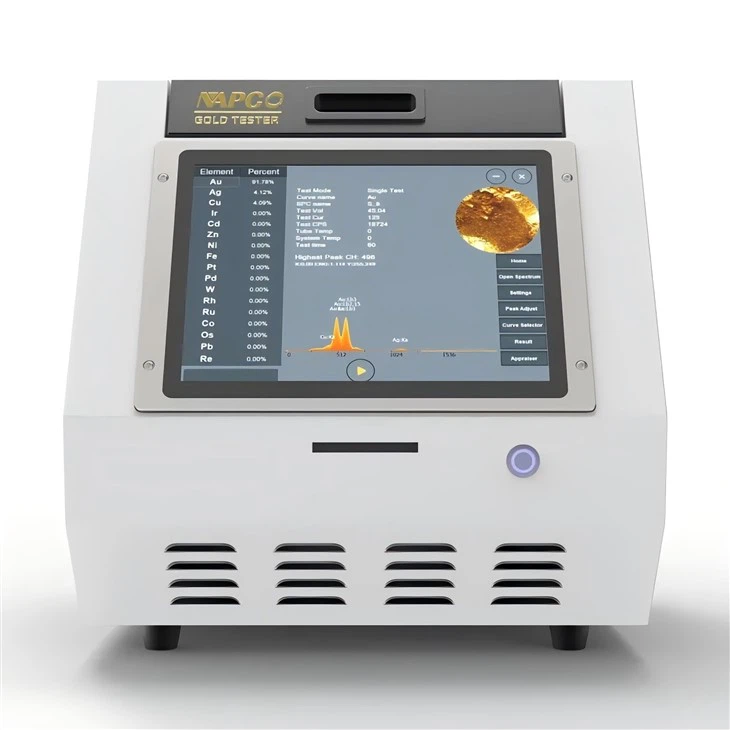
So, how do you choose the right gold testing machine for your needs? Well, it really depends on what you're using the machine for. If you're just testing jewelry or other consumer products, a machine with a detection limit of around 0.1% should be sufficient. However, if you're working with high-purity gold samples or need to detect very low levels of gold, you'll want to consider a machine with a lower detection limit, such as the NAP 8200E or the N1-25.
In addition to the detection limit, you'll also want to consider other factors when choosing a gold testing machine. These include the price of the machine, its ease of use, its reliability, and the level of support and service offered by the manufacturer.
At our company, we're committed to providing our customers with the highest quality gold testing machines at competitive prices. We offer a wide range of models to choose from, each with its own unique features and capabilities. Whether you're a small business owner, a jeweler, or a researcher, we have a machine that's right for you.
If you're interested in learning more about our gold testing machines or have any questions about their detection limits or other features, please don't hesitate to contact us. We'd be happy to help you choose the right machine for your needs and answer any questions you may have.
In conclusion, the detection limit of a gold testing machine is an important factor to consider when choosing a machine. It determines how sensitive the machine is and how reliable its results are, especially when dealing with small or trace amounts of gold. By understanding the factors that affect the detection limit and choosing a machine that's right for your needs, you can ensure that you're getting accurate and reliable results every time.
So, if you're in the market for a gold testing machine, give us a call or send us an email. We'd love to hear from you and help you find the perfect machine for your business.
References
- "X-ray Fluorescence Spectroscopy: Principles and Applications" by Brian L. Henke
- "Handbook of X-ray Spectrometry" by John R. De Vries