


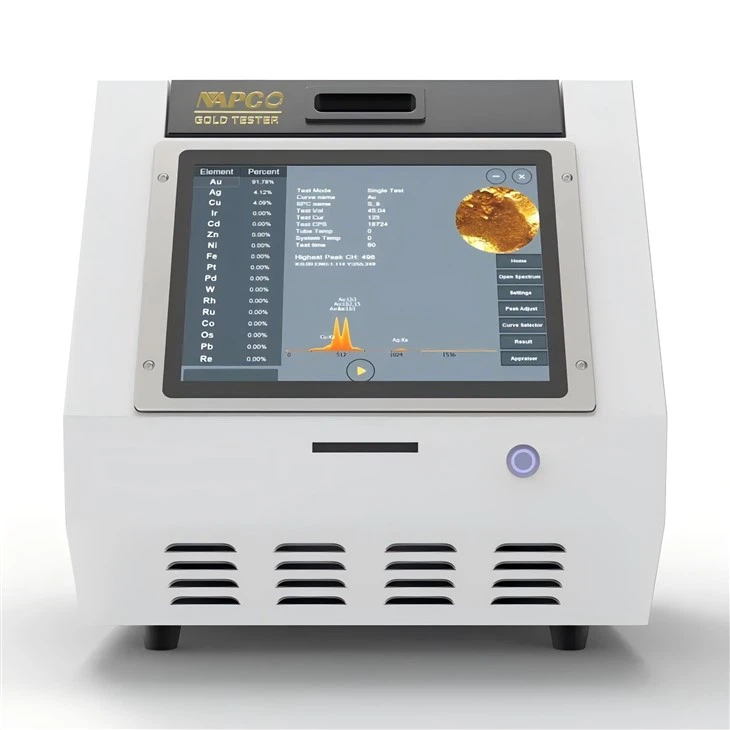
As a leading supplier of gold spectrometers, I often encounter inquiries about the technical aspects of these instruments. One of the most frequently asked questions is about the angular dispersion of a gold spectrometer. In this blog post, I will delve into what angular dispersion is, its significance in gold spectrometers, and how it impacts the performance of our products such as the N1-25 XRF Gold Tester, N1-10 XRF Gold Tester, and NAP 8200E XRF Gold Tester.
Understanding Angular Dispersion
Angular dispersion is a fundamental concept in spectroscopy. It refers to the separation of different wavelengths of light by an optical element, such as a prism or a diffraction grating, as a function of the angle of deviation. When light passes through an optical element, different wavelengths are refracted or diffracted at different angles. This phenomenon is the basis for the spectral analysis in a gold spectrometer.
In a gold spectrometer, the goal is to accurately measure the elemental composition of a gold sample. Different elements emit or absorb light at specific wavelengths. By separating these wavelengths using angular dispersion, the spectrometer can identify and quantify the elements present in the sample.

The Role of Angular Dispersion in Gold Spectrometers
In a gold spectrometer, angular dispersion plays a crucial role in several aspects:
Elemental Identification
Each element has a unique set of spectral lines, which are specific wavelengths of light that are either emitted or absorbed by the element. By separating these spectral lines through angular dispersion, the spectrometer can distinguish between different elements. For example, gold has its own characteristic spectral lines, as do other elements commonly found in gold alloys, such as silver, copper, and platinum. The ability to accurately separate these lines is essential for identifying the elements present in a gold sample.
Quantitative Analysis
Once the elements are identified, the spectrometer needs to determine their concentrations in the sample. The intensity of the spectral lines is proportional to the amount of the element present in the sample. By accurately measuring the intensity of each spectral line, which is made possible by the angular dispersion, the spectrometer can perform quantitative analysis. This allows users to determine the purity of the gold sample, as well as the concentrations of other elements in the alloy.
Resolution
Resolution is a measure of the spectrometer's ability to distinguish between two closely spaced spectral lines. A higher resolution means that the spectrometer can separate spectral lines that are closer together. Angular dispersion directly affects the resolution of the spectrometer. A larger angular dispersion allows for better separation of spectral lines, resulting in higher resolution. This is particularly important when analyzing gold samples, as some elements may have spectral lines that are very close together.
How Our Gold Spectrometers Utilize Angular Dispersion
At our company, we have designed our gold spectrometers to optimize the use of angular dispersion for accurate and reliable analysis. Our N1-25 XRF Gold Tester, N1-10 XRF Gold Tester, and NAP 8200E XRF Gold Tester are equipped with high-quality optical elements that provide excellent angular dispersion.
Advanced Optical Design
Our spectrometers use state-of-the-art diffraction gratings or prisms to achieve high angular dispersion. These optical elements are carefully selected and designed to provide maximum separation of spectral lines. The advanced optical design ensures that the spectrometer can accurately identify and quantify the elements in a gold sample, even in complex alloys.
High-Resolution Detection
To take full advantage of the angular dispersion, our spectrometers are equipped with high-resolution detectors. These detectors can accurately measure the intensity of the spectral lines, even when they are very close together. This allows for precise quantitative analysis of the gold sample, with high accuracy and repeatability.
Calibration and Optimization
We also perform extensive calibration and optimization of our spectrometers to ensure that the angular dispersion is accurately calibrated. This includes calibrating the spectrometer with known standards to ensure that the spectral lines are correctly identified and measured. Our calibration procedures are designed to minimize errors and ensure the highest level of accuracy in the analysis.
Benefits of Our Gold Spectrometers with Optimal Angular Dispersion
Accurate Elemental Analysis
The optimal angular dispersion in our gold spectrometers allows for highly accurate elemental analysis. Whether you are analyzing pure gold or a complex gold alloy, our spectrometers can accurately identify and quantify the elements present in the sample. This is essential for ensuring the quality and purity of gold products.
Fast and Efficient Analysis
Our spectrometers are designed to provide fast and efficient analysis. The high angular dispersion allows for quick separation of spectral lines, reducing the analysis time. This is particularly important in industrial applications, where large numbers of samples need to be analyzed quickly.
User-Friendly Operation
Despite their advanced technology, our gold spectrometers are designed to be user-friendly. The software interface is intuitive and easy to use, allowing users to quickly obtain accurate results. Our spectrometers also require minimal maintenance, making them a cost-effective solution for gold analysis.
Conclusion
Angular dispersion is a critical concept in the operation of a gold spectrometer. It plays a key role in elemental identification, quantitative analysis, and resolution. At our company, we have designed our gold spectrometers, such as the N1-25 XRF Gold Tester, N1-10 XRF Gold Tester, and NAP 8200E XRF Gold Tester, to optimize the use of angular dispersion for accurate and reliable analysis.
If you are in the market for a high-quality gold spectrometer, we invite you to contact us for more information. Our team of experts is ready to assist you in selecting the right spectrometer for your needs and to provide you with the support and training you need to get the most out of your instrument. Whether you are a jeweler, a gold refiner, or a researcher, our gold spectrometers can provide you with the accurate and reliable analysis you need.
References
- Hecht, E. (2017). Optics (5th ed.). Pearson.
- Harris, D. C. (2015). Quantitative Chemical Analysis (9th ed.). W. H. Freeman and Company.
- Skoog, D. A., West, D. M., Holler, F. J., & Crouch, S. R. (2014). Fundamentals of Analytical Chemistry (9th ed.). Cengage Learning.