


Hey there! As a supplier of XRF testing equipment for gold, I often get asked about how XRF testing works, especially when it comes to gold with inclusions. So, let's dive right in and break it down.
What is XRF Testing?
First things first, XRF stands for X-ray fluorescence. It's a non-destructive analytical technique used to determine the elemental composition of a sample. In the context of gold testing, XRF can quickly and accurately tell you the purity of the gold and identify other elements present in the sample, including those pesky inclusions.
Here's the basic science behind it. When an X-ray beam is directed at a sample, it causes the atoms in the sample to emit secondary X-rays, or fluorescence. Each element emits X-rays at specific wavelengths, which are like fingerprints. By measuring these wavelengths and their intensities, we can figure out what elements are in the sample and how much of each is there.
How XRF Testing Handles Gold with Inclusions
Now, let's talk about gold with inclusions. Inclusions are foreign materials trapped inside the gold during its formation or processing. They can be anything from other metals like copper, silver, or zinc to non-metallic substances like quartz or pyrite. These inclusions can affect the accuracy of gold purity measurements, but XRF testing is up to the challenge.
Detecting Different Elements
One of the great things about XRF testing is its ability to detect a wide range of elements. When testing gold with inclusions, the XRF machine will analyze the entire sample, including the gold and the inclusions. It can distinguish between the characteristic X-ray emissions of gold and those of other elements. For example, copper has its own unique set of X-ray wavelengths, so the machine can tell if there's copper in the sample and how much.
Calculating Gold Purity
Once the XRF machine has identified all the elements in the sample, it uses a calibration curve to calculate the gold purity. This curve is based on known standards of different gold alloys. The machine compares the X-ray intensities of the sample to those of the standards to determine the percentage of gold in the sample.
However, inclusions can complicate things. If the inclusions are made of elements that are commonly found in gold alloys, like copper or silver, the machine might mistake them for part of the alloy. That's why it's important to have a good understanding of the sample and to use appropriate calibration settings.
Dealing with Non-Homogeneous Samples
Gold with inclusions is often non-homogeneous, meaning the distribution of elements is not uniform throughout the sample. This can make it tricky to get an accurate measurement. To address this, XRF machines are designed to take multiple readings from different areas of the sample. By averaging these readings, we can get a more representative result.
Our XRF Gold Testers
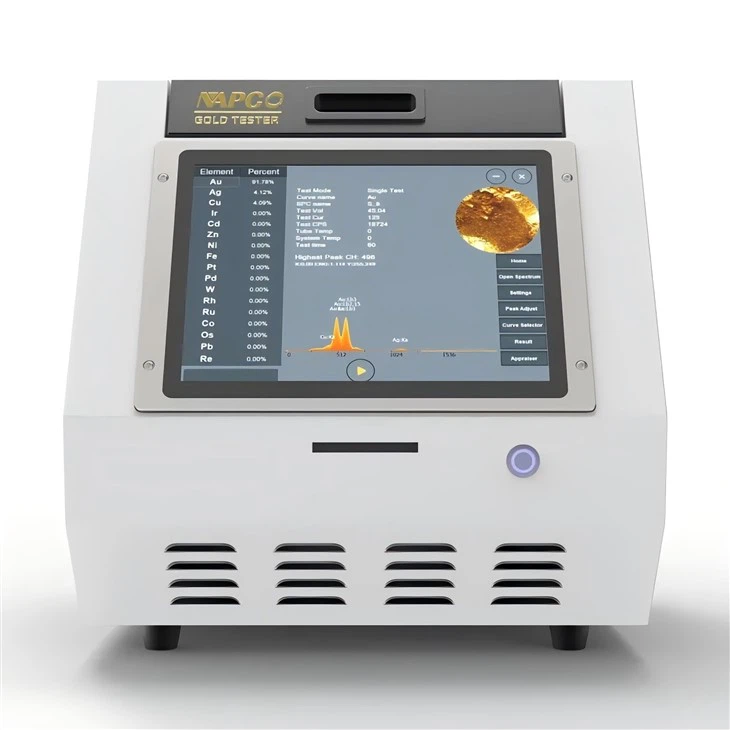
At our company, we offer a range of high-quality XRF gold testers that are specifically designed to handle gold with inclusions. Here are some of our top models:
- N1 XRF Gold Tester: This compact and portable tester is perfect for on-the-go testing. It offers fast and accurate results, even for samples with complex inclusions.
- NAP 8200E XRF Gold Tester: This benchtop model is a workhorse. It has a large sample chamber and advanced software that can handle even the most challenging samples. It's ideal for high-volume testing in a laboratory or industrial setting.
- NA 8500 XRF Gold Tester: This state-of-the-art tester offers the highest level of accuracy and precision. It uses the latest XRF technology to provide detailed elemental analysis of gold samples with inclusions.
Why Choose Our XRF Gold Testers?
There are several reasons why our XRF gold testers are the best choice for testing gold with inclusions:
Accuracy
Our testers are calibrated to provide highly accurate results. They use advanced algorithms and calibration curves to account for the presence of inclusions and other factors that can affect the measurement.
Speed
Time is money, especially in the gold industry. Our XRF testers can provide results in a matter of seconds, allowing you to make quick decisions about the value of your gold samples.
Non-Destructive
Unlike some other testing methods, XRF testing is non-destructive. This means you can test your gold samples without damaging them, which is especially important for valuable or rare pieces.
Ease of Use
Our testers are designed to be user-friendly, even for those with little or no experience in XRF testing. They come with intuitive software and clear instructions, making it easy to operate the machine and interpret the results.
Contact Us for Your XRF Gold Testing Needs
If you're in the market for an XRF gold tester, we'd love to hear from you. Whether you're a jeweler, a gold dealer, or a laboratory looking to upgrade your testing equipment, we have the right solution for you. Our team of experts is always on hand to answer your questions and help you choose the best tester for your needs.

So, don't hesitate to reach out and start a conversation. Let's work together to ensure you get the most accurate and reliable gold testing results possible.
References
- "X-ray Fluorescence Spectrometry: Principles and Applications" by Ronald Jenkins
- "Handbook of Applied X-ray Analysis" by Brian L. Henke, Elaine M. Gullikson, and Janice C. Davis