


Can XRF Test Detect Gold in Composite Materials?

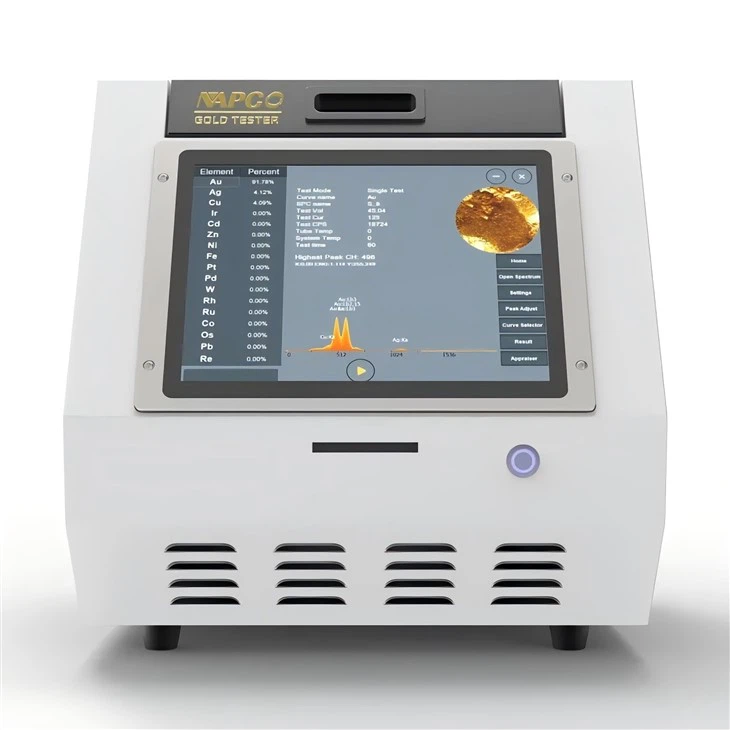
As a supplier of XRF gold testing equipment, I am often asked whether XRF tests can effectively detect gold in composite materials. In this blog post, I will delve into the science behind XRF testing, its capabilities in detecting gold within composite materials, and the advantages of using our advanced XRF gold testers.
Understanding XRF Testing
X-ray fluorescence (XRF) is a non-destructive analytical technique used to determine the elemental composition of a sample. When an X-ray beam is directed at a sample, the atoms in the sample absorb the X-rays and then emit secondary X-rays, known as fluorescent X-rays. The energy of these fluorescent X-rays is characteristic of the elements present in the sample. By measuring the energy and intensity of the fluorescent X-rays, an XRF spectrometer can identify and quantify the elements in the sample.
Detecting Gold in Composite Materials
Composite materials are made up of two or more distinct components, often with different physical and chemical properties. Detecting gold in composite materials can be challenging due to several factors. Firstly, the gold may be present in small quantities, making it difficult to detect. Secondly, the presence of other elements in the composite material can interfere with the XRF analysis. However, modern XRF technology has advanced significantly, and our XRF gold testers are designed to overcome these challenges.
Our N1 XRF Gold Tester is equipped with high-resolution detectors and advanced software algorithms that can accurately detect gold even in complex composite materials. The tester can analyze a wide range of elements simultaneously, allowing for a comprehensive analysis of the sample. Additionally, the N1 XRF Gold Tester has a fast analysis speed, which means that you can get results quickly, saving you time and increasing your productivity.
The NA 6500 XRF Gold Tester is another powerful tool for detecting gold in composite materials. It features a large sample chamber, which can accommodate larger samples, and a high-intensity X-ray tube, which provides a stronger signal for more accurate analysis. The NA 6500 XRF Gold Tester also has a user-friendly interface, making it easy to operate even for those with limited technical knowledge.
For more demanding applications, our NAP 8200E XRF Gold Tester is the ideal choice. It offers the highest level of accuracy and sensitivity, making it suitable for detecting trace amounts of gold in composite materials. The NAP 8200E XRF Gold Tester is also equipped with advanced features such as automatic sample positioning and real-time data analysis, which further enhance its performance.
Advantages of Using XRF Testing for Gold Detection in Composite Materials
There are several advantages to using XRF testing for detecting gold in composite materials. Firstly, XRF testing is non-destructive, which means that the sample remains intact after the analysis. This is particularly important when dealing with valuable or irreplaceable samples. Secondly, XRF testing is fast and efficient, providing results in a matter of minutes. This allows for rapid decision-making and increased productivity. Thirdly, XRF testing is highly accurate, with a precision of up to ±0.1% for gold analysis. This ensures that you can rely on the results for your business decisions.
Factors Affecting the Accuracy of XRF Testing
While XRF testing is a powerful tool for detecting gold in composite materials, there are several factors that can affect its accuracy. These include the sample preparation, the presence of interfering elements, and the calibration of the XRF spectrometer.
Sample preparation is crucial for obtaining accurate results. The sample should be clean and free of contaminants, and it should be representative of the entire composite material. If the sample is not properly prepared, the results may be inaccurate.
The presence of interfering elements can also affect the accuracy of XRF testing. Some elements, such as iron, copper, and zinc, can produce fluorescent X-rays with energies similar to those of gold, which can lead to false positives or inaccurate quantification. To overcome this issue, our XRF gold testers are equipped with advanced software algorithms that can correct for the presence of interfering elements.
Calibration is another important factor in ensuring the accuracy of XRF testing. The XRF spectrometer should be calibrated regularly using certified reference materials to ensure that it is providing accurate results. Our XRF gold testers come with a comprehensive calibration package, which includes certified reference materials and detailed instructions for calibration.
Conclusion
In conclusion, XRF testing is a reliable and effective method for detecting gold in composite materials. Our advanced XRF gold testers, such as the N1 XRF Gold Tester, NA 6500 XRF Gold Tester, and NAP 8200E XRF Gold Tester, are designed to overcome the challenges associated with detecting gold in composite materials and provide accurate and reliable results.
If you are interested in purchasing an XRF gold tester for your business, please feel free to contact us for more information. Our team of experts will be happy to assist you in selecting the right XRF gold tester for your needs and provide you with the support and training you need to get the most out of your investment.
References
- Jenkins, R., Gould, R. W., & Gedcke, D. (1995). Quantitative X-ray fluorescence analysis. Marcel Dekker.
- Van Grieken, R., & Markowicz, A. A. (2002). Handbook of X-ray fluorescence spectrometry. Marcel Dekker.
- Potts, P. J., & Webb, P. C. (2006). X-ray fluorescence spectrometry. In Encyclopedia of Analytical Chemistry (pp. 10434-10477). John Wiley & Sons, Ltd.