


Hey there! As a supplier of XRF gold testers, I often get asked about how XRF stacks up against XRD when it comes to gold analysis. So, I thought I'd break it down for you in this blog post.
Let's start with a quick intro to what XRF and XRD actually are. XRF, or X-ray fluorescence, is a technique that measures the elemental composition of a sample by exciting the atoms in it with X-rays. When the atoms are excited, they emit characteristic X-rays that can be detected and analyzed to determine the elements present and their concentrations. On the other hand, XRD, or X-ray diffraction, is used to analyze the crystal structure of a material. It works by shining X-rays onto a sample and measuring the pattern of the diffracted X-rays, which can reveal the arrangement of atoms in the crystal lattice.
Speed and Efficiency
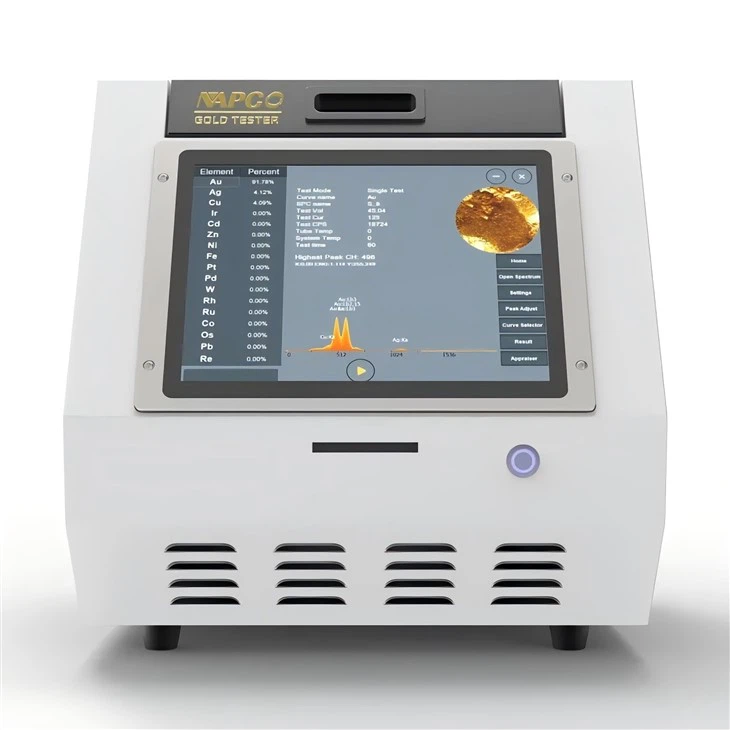
One of the biggest advantages of XRF for gold analysis is its speed. With an NAP 8200E XRF Gold Tester, you can get results in a matter of seconds or minutes. This is great for high - throughput applications, like testing a large number of gold samples in a jewelry manufacturing or trading environment. You don't have to wait around for hours or days to get the information you need.
In contrast, XRD analysis can be much slower. Preparing the sample for XRD often involves grinding it into a fine powder and mounting it carefully. Then, the actual measurement can take a long time, sometimes several hours, depending on the complexity of the sample and the level of detail required. So, if you're in a hurry to get your gold analyzed, XRF is definitely the way to go.
Sample Preparation
XRF is also incredibly easy when it comes to sample preparation. You can test a wide variety of gold samples, including jewelry, coins, and gold bars, without much pre - treatment. You just place the sample in the tester, and it does its thing. This is a huge plus, especially for those who don't have a lot of time or resources for elaborate sample preparation.
XRD, however, requires more meticulous sample preparation. As I mentioned earlier, the sample usually needs to be ground into a powder to ensure a uniform diffraction pattern. This can be a time - consuming and tricky process, especially for precious gold samples where you don't want to lose any material.
Portability
If you need to do on - site gold analysis, XRF has a clear edge. There are portable N1 - 25 XRF Gold Tester and N1 - 10 XRF Gold Tester models available that you can take with you to different locations. Whether you're at a gold mine, a pawn shop, or a jewelry trade show, you can easily test the gold samples right then and there.
XRD machines are generally large, bulky, and require a stable laboratory environment. They're not really suitable for on - site analysis, which limits their use in certain situations.
Depth of Analysis
XRF is great for surface and near - surface analysis. It can tell you the elemental composition of the outer layer of the gold sample. However, it has limitations when it comes to analyzing the internal structure or inclusions within the sample.

XRD, on the other hand, can provide detailed information about the crystal structure of the gold. This can be useful for identifying impurities, determining the phase of the gold, and understanding the growth history of the sample. So, if you need in - depth structural information about your gold, XRD might be a better choice.
Cost
When it comes to cost, XRF is usually more budget - friendly. The initial purchase price of an XRF gold tester is generally lower than that of an XRD machine. Additionally, the operating costs of XRF are also relatively low. You don't need a lot of expensive consumables or highly specialized personnel to operate it.
XRD machines are more expensive to buy and maintain. They require a well - equipped laboratory, trained technicians, and often more expensive consumables. So, if you're on a tight budget, XRF is a more cost - effective option.
Accuracy for Gold Purity
For determining the purity of gold, XRF can be quite accurate. Modern XRF gold testers can provide results with a high degree of precision, especially for samples with a relatively simple elemental composition. However, XRF might have some limitations when it comes to detecting very low - level impurities or when the sample has a complex alloy structure.
XRD can also contribute to understanding the purity of gold, but its main strength lies in the structural analysis rather than direct elemental quantification. It can help in identifying the presence of different phases that might affect the overall quality and purity of the gold.
Applications
XRF is widely used in the jewelry industry for quick and easy gold testing. It's also popular in the gold trading and recycling sectors, where fast and reliable results are essential. In these industries, the ability to test multiple samples quickly can save a lot of time and money.
XRD is more commonly used in research and development, as well as in some high - end quality control applications. For example, in a gold mining research project, XRD can be used to study the crystal structure of gold ores to optimize the extraction process.
Conclusion
So, which one is better for gold analysis, XRF or XRD? Well, it really depends on your specific needs. If you need a fast, easy, and cost - effective way to test the elemental composition of your gold samples, especially in a high - throughput environment, XRF is the winner. Our NAP 8200E XRF Gold Tester, N1 - 25 XRF Gold Tester, and N1 - 10 XRF Gold Tester are all great options that can meet your requirements.
On the other hand, if you need detailed structural information about your gold samples, such as for research or high - end quality control, XRD might be more suitable.
If you're interested in learning more about our XRF gold testers or have any questions about gold analysis, don't hesitate to reach out. We're here to help you make the best choice for your gold testing needs. Contact us today to start a conversation about your procurement requirements.
References
- Smith, J. (2018). "Advances in X - ray Fluorescence Analysis for Precious Metals". Journal of Analytical Chemistry.
- Johnson, A. (2019). "X - ray Diffraction Techniques in Gold Research". Mineralogical Review.