


XRF (X-ray Fluorescence) gold testers have become indispensable tools in the jewelry and precious metals industry. As a supplier of XRF gold testers, I've witnessed firsthand the transformative impact these devices have on quickly and non-destructively analyzing the composition of gold and other precious metals. However, like any technology, XRF gold testers are not without their limitations. In this blog post, I'll explore some of these limitations to provide a comprehensive understanding of what XRF gold testers can and cannot do.
1. Surface Analysis Limitation
One of the primary limitations of XRF gold testers is that they are essentially surface analysis tools. XRF technology works by emitting X-rays onto the surface of a sample, and then measuring the fluorescent X-rays emitted by the elements in the sample. The depth of penetration of the X-rays is typically very shallow, usually on the order of a few micrometers to a few millimeters, depending on the density of the material and the energy of the X-rays.
This means that if a gold item has a surface coating or plating, the XRF tester will primarily analyze the composition of the coating rather than the underlying material. For example, a piece of jewelry that appears to be solid gold on the outside but is actually made of a base metal with a thin gold plating will give a false reading if tested using an XRF gold tester. The tester will detect the gold in the plating and may overestimate the overall gold content of the item.
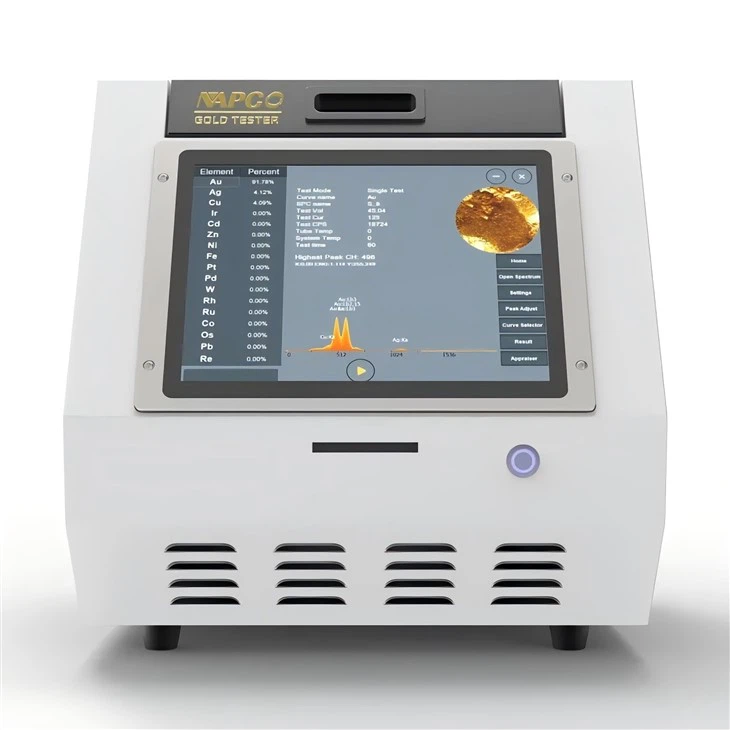
Our NAP 8200E XRF Gold Tester is designed to provide accurate surface analysis, but users need to be aware of this limitation when dealing with potentially plated items. In some cases, additional testing methods, such as acid testing or destructive analysis, may be required to determine the true composition of the item.
2. Limited Element Detection
XRF gold testers are capable of detecting a wide range of elements commonly found in gold alloys, such as silver, copper, zinc, and nickel. However, there are limitations to the elements that can be detected. XRF technology is most effective at detecting elements with atomic numbers above a certain threshold, typically around 11 (sodium). Elements with lower atomic numbers, such as hydrogen, helium, and lithium, are difficult or impossible to detect using XRF.
In addition, some elements may be present in very low concentrations in a gold alloy, and the XRF tester may not be sensitive enough to detect them. For example, trace elements that are added to gold alloys for specific purposes, such as improving the hardness or color of the metal, may be present in concentrations below the detection limit of the XRF tester. This can lead to an incomplete analysis of the alloy composition.
Our NA 8500 XRF Gold Tester offers high sensitivity and can detect a wide range of elements, but it's important to note that there are still limitations to the elements that can be accurately measured. In some cases, more advanced analytical techniques, such as inductively coupled plasma mass spectrometry (ICP-MS), may be required to detect trace elements in gold alloys.
3. Matrix Effects
Matrix effects refer to the influence of the sample matrix (the overall composition of the sample) on the XRF measurement. Different elements in a sample can interact with each other and affect the intensity of the fluorescent X-rays emitted by the elements of interest. This can lead to inaccurate results if the matrix effects are not properly accounted for.
For example, in a gold alloy that contains a high concentration of a particular element, such as copper, the presence of copper can absorb or scatter the X-rays and reduce the intensity of the fluorescent X-rays emitted by the gold. This can result in an underestimation of the gold content in the alloy. To compensate for matrix effects, XRF gold testers typically use calibration curves that are specific to different types of gold alloys. However, these calibration curves may not be accurate for all types of samples, especially those with complex or unusual compositions.
Our N1 XRF Gold Tester is equipped with advanced algorithms to minimize matrix effects, but users need to ensure that the calibration is appropriate for the samples being tested. In some cases, it may be necessary to use reference standards with similar compositions to the samples to improve the accuracy of the measurement.
4. Sample Geometry and Homogeneity
The geometry and homogeneity of the sample can also affect the accuracy of the XRF measurement. XRF gold testers are designed to analyze flat, smooth surfaces, and irregularly shaped or rough samples may not provide accurate results. If the sample has a complex shape or a non-uniform surface, the X-rays may not be evenly distributed across the sample, and the fluorescent X-rays may be scattered or absorbed in different ways, leading to inconsistent measurements.
In addition, if the sample is not homogeneous, meaning that the composition varies within the sample, the XRF measurement may only represent the composition of the area that is being analyzed. For example, a gold alloy that has a heterogeneous distribution of elements due to improper mixing during the manufacturing process may give different results depending on where the sample is tested.
To obtain accurate results, it's important to prepare the sample properly and ensure that it has a flat, smooth surface. If the sample is not homogeneous, multiple measurements may need to be taken at different locations on the sample to get a more representative analysis.

5. Calibration and Standardization
Calibration and standardization are crucial for ensuring the accuracy of XRF gold testers. XRF measurements are based on the comparison of the fluorescent X-rays emitted by the sample with those emitted by reference standards of known composition. If the calibration is not accurate or the reference standards are not properly prepared, the results of the XRF measurement may be unreliable.
Calibration of an XRF gold tester involves adjusting the instrument parameters to ensure that the measured values match the known values of the reference standards. This process requires careful attention to detail and regular maintenance to ensure that the calibration remains accurate over time. In addition, the reference standards used for calibration should be traceable to national or international standards to ensure their accuracy and reliability.
As a supplier, we provide our customers with detailed instructions on how to calibrate and maintain our XRF gold testers. We also offer a range of reference standards to help our customers ensure the accuracy of their measurements. However, it's important for users to understand the importance of calibration and to follow the recommended procedures to obtain reliable results.
Conclusion
In conclusion, XRF gold testers are powerful tools for quickly and non-destructively analyzing the composition of gold and other precious metals. However, they have several limitations that need to be considered when using these devices. Surface analysis limitations, limited element detection, matrix effects, sample geometry and homogeneity, and calibration and standardization issues can all affect the accuracy of the XRF measurement.
As a supplier of XRF gold testers, we are committed to providing our customers with high-quality products and comprehensive support. Our NAP 8200E XRF Gold Tester, NA 8500 XRF Gold Tester, and N1 XRF Gold Tester are designed to minimize these limitations and provide accurate results. However, it's important for users to be aware of these limitations and to use the testers in conjunction with other testing methods when necessary.
If you're interested in learning more about our XRF gold testers or have any questions about their limitations and applications, please feel free to contact us for a detailed discussion. We're here to help you make an informed decision and ensure that you get the most accurate results from your XRF gold testing.
References
- Jenkins, R. (1999). X-ray Fluorescence Spectrometry. John Wiley & Sons.
- Criss, R. E., & Birks, L. S. (1968). The influence of the matrix on x-ray emission in quantitative analysis. Analytical Chemistry, 40(13), 1904-1909.
- Van Grieken, R., & Markowicz, A. A. (2002). Handbook of X-Ray Spectrometry. Marcel Dekker.