


Hey there, fellow gold enthusiasts! As a supplier of gold testing machines, I often get asked about the minimum gold content our machines can detect. It's a crucial question, especially for jewelers, pawnbrokers, and anyone dealing with gold on a regular basis. So, let's dive right into it.
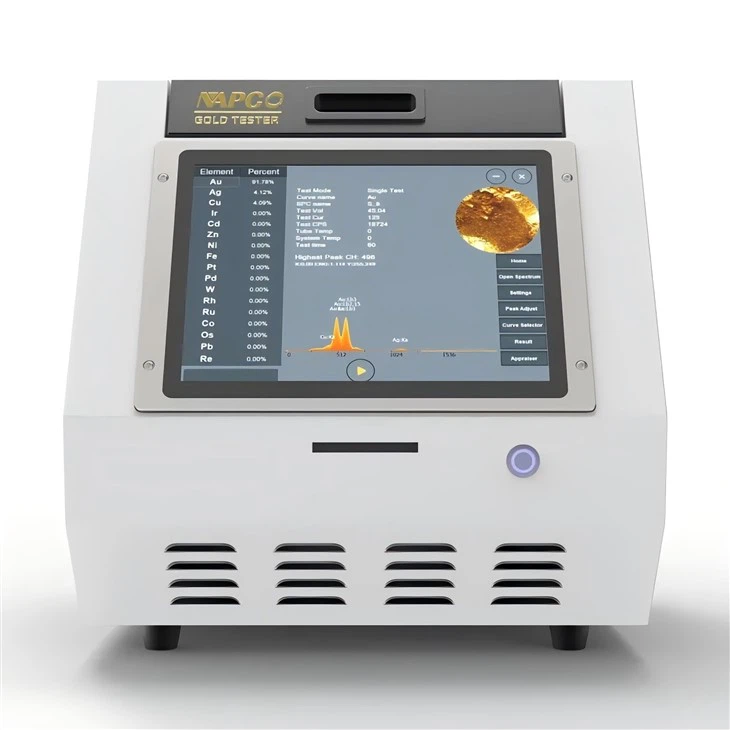

First off, the ability of a gold testing machine to detect the minimum gold content depends on several factors. One of the most important is the technology used in the machine. At our company, we mainly offer XRF (X-ray Fluorescence) gold testers, which are known for their accuracy and non-destructive testing capabilities.
XRF technology works by bombarding the sample with X-rays. These X-rays cause the atoms in the sample to emit secondary X-rays, and the energy of these secondary X-rays is characteristic of the elements present in the sample. By analyzing the energy spectrum of these secondary X-rays, the machine can determine the elemental composition of the sample, including the gold content.
Now, let's talk about the minimum gold content our XRF gold testers can detect. Our NAP 8200E XRF Gold Tester is a high - end benchtop model. It's equipped with advanced sensors and software that allow it to detect gold content as low as 0.1%. That means even if a sample has only 0.1 grams of gold per 100 grams of the total material, the NAP 8200E can identify it. This is incredibly useful for detecting trace amounts of gold in alloys or for verifying the purity of gold - plated items.
The NA 6500 XRF Gold Tester is another great option. It's a bit more budget - friendly but still offers excellent performance. This machine can detect gold content down to 0.5%. While it's not as sensitive as the NAP 8200E, it's more than sufficient for most common applications, such as testing the purity of gold jewelry in a retail setting.
Our N1 XRF Gold Tester is a compact and portable model. It's perfect for on - the - go testing, like at trade shows or in the field. Despite its small size, it can detect gold content as low as 1%. This makes it a great choice for quick and easy testing of samples with relatively higher gold content.
But why is it important to know the minimum gold content a machine can detect? Well, for jewelers, it helps in accurately pricing their products. If a piece of jewelry has a very low gold content, it should be priced accordingly. Pawnbrokers also need to know the exact gold content to make fair offers when buying gold items. And for gold miners and refiners, it's essential for quality control and ensuring the purity of the final product.
Another factor that can affect the minimum detectable gold content is the sample size and shape. Generally, larger and more homogeneous samples will give more accurate results. If the sample is too small or has an irregular shape, it might be more difficult for the machine to get a representative reading. For example, a thin gold - plated wire might be harder to test accurately compared to a solid gold bar.
The surface condition of the sample also matters. If the sample has a dirty or oxidized surface, it can interfere with the X - ray analysis. So, it's a good idea to clean the sample before testing to get the most accurate results.
In addition to the minimum detectable gold content, it's also important to consider the accuracy and precision of the machine. Accuracy refers to how close the measured value is to the true value, while precision refers to how reproducible the measurements are. Our XRF gold testers are designed to be both highly accurate and precise. They undergo rigorous calibration and quality control procedures to ensure reliable performance.
When choosing a gold testing machine, you should also think about your specific needs. If you're a large - scale gold refiner, you might need a high - end machine like the NAP 8200E that can detect very low levels of gold with high accuracy. On the other hand, if you're a small - scale jeweler, the NA 6500 or the N1 might be more suitable for your day - to - day testing needs.
We also offer training and support for our customers. Our team of experts can help you set up the machine, teach you how to use it properly, and troubleshoot any issues that might arise. We believe that providing excellent customer service is just as important as selling high - quality products.
If you're in the market for a gold testing machine and want to learn more about our products, or if you have any questions about the minimum gold content our machines can detect, don't hesitate to reach out. Whether you're a seasoned professional in the gold industry or just starting out, we're here to help you make the right choice.
In conclusion, the minimum gold content a gold testing machine can detect depends on the technology, sample characteristics, and the specific model of the machine. Our XRF gold testers, including the NAP 8200E, NA 6500, and N1, offer a range of detection capabilities to meet different needs. So, if you're looking for a reliable and accurate way to test the gold content of your samples, we've got you covered.
If you're interested in purchasing one of our gold testing machines or want to discuss your requirements further, feel free to contact us. We're always happy to have a chat and help you find the perfect solution for your business.
References:
- X - ray Fluorescence Spectroscopy: Principles and Applications, John Wiley & Sons
- Handbook of Gold Refining and Recycling, Springer