


As a supplier of XRF gold testers, I often encounter questions from customers about the linearity of our products' measurements. Linearity is a crucial concept in the field of analytical instrumentation, and understanding it is essential for anyone looking to purchase an XRF gold tester. In this blog post, I will explain what linearity means in the context of XRF gold testing, why it matters, and how our XRF gold testers ensure high linearity.
What is Linearity in XRF Gold Testing?
In the world of XRF (X-ray fluorescence) gold testing, linearity refers to the relationship between the concentration of gold in a sample and the signal intensity detected by the XRF gold tester. Ideally, this relationship should be linear, meaning that as the concentration of gold in the sample increases, the signal intensity detected by the tester also increases in a directly proportional manner.
To illustrate this concept, let's consider a simple example. Suppose we have a series of gold samples with known concentrations ranging from 10% to 90%. When we analyze these samples using an XRF gold tester, we expect the signal intensity detected by the tester to increase linearly with the gold concentration. If the relationship is perfectly linear, a graph plotting the signal intensity against the gold concentration would be a straight line.
Why Does Linearity Matter?
The linearity of an XRF gold tester's measurement is important for several reasons. Firstly, it ensures the accuracy and reliability of the test results. A linear relationship between the gold concentration and the signal intensity allows for more precise calibration of the tester, which in turn leads to more accurate measurement of the gold content in unknown samples.
Secondly, linearity is essential for quantitative analysis. In many applications, such as gold trading and jewelry manufacturing, it is necessary to know the exact concentration of gold in a sample. A non-linear relationship between the gold concentration and the signal intensity can make it difficult to accurately determine the gold content, leading to errors in the analysis.
Finally, linearity is important for quality control. In a production environment, it is crucial to ensure that the XRF gold tester provides consistent and reproducible results. A linear measurement system is more likely to produce consistent results over time, which helps to maintain the quality and integrity of the products being tested.
How Our XRF Gold Testers Ensure High Linearity
At our company, we understand the importance of linearity in XRF gold testing, and we have taken several steps to ensure that our XRF gold testers provide high linearity.
Advanced Detector Technology
Our XRF gold testers are equipped with advanced detector technology that is designed to accurately detect and measure the X-ray fluorescence signals emitted by the gold samples. These detectors have high sensitivity and resolution, which allows them to detect even small changes in the signal intensity, ensuring a linear response over a wide range of gold concentrations.
Precise Calibration
We use a rigorous calibration process to ensure that our XRF gold testers are accurately calibrated for linearity. During the calibration process, we use a series of certified reference materials with known gold concentrations to establish the relationship between the signal intensity and the gold concentration. This calibration curve is then used to convert the measured signal intensity into the actual gold concentration in the sample.
Quality Control and Testing
Before our XRF gold testers are shipped to customers, they undergo extensive quality control and testing to ensure that they meet our high standards for linearity. We use a variety of test methods and procedures to verify the linearity of the testers, including linear regression analysis and comparison with independent reference methods.

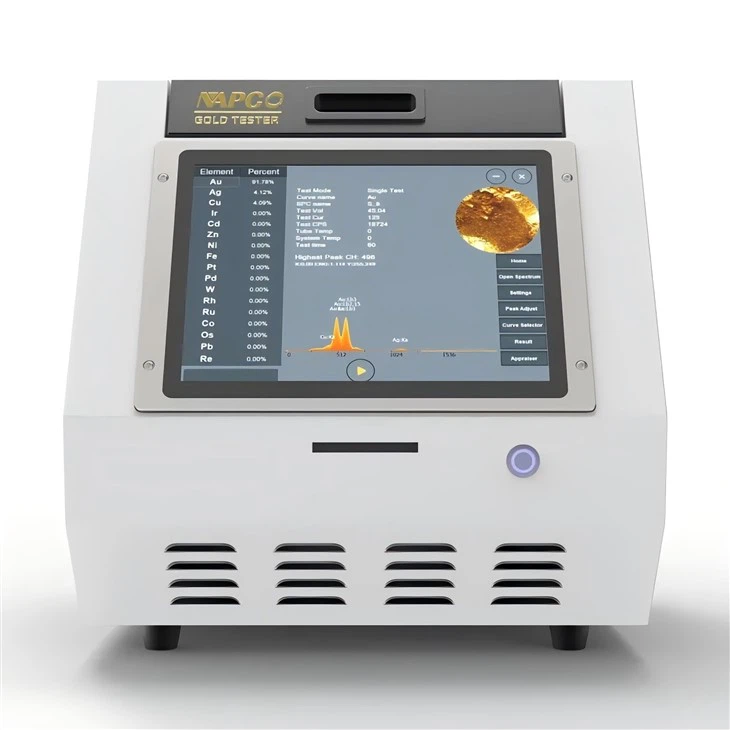
Examples of Our XRF Gold Testers with High Linearity
We offer a range of XRF gold testers that are designed to provide high linearity and accurate measurement of gold content. Here are some examples of our popular models:
- N1 XRF Gold Tester: The N1 XRF Gold Tester is a compact and portable benchtop instrument that is ideal for small-scale gold testing applications. It features advanced detector technology and precise calibration, ensuring high linearity and accurate measurement of gold content.
- NAP 8200E XRF Gold Tester: The NAP 8200E XRF Gold Tester is a high-performance benchtop instrument that is suitable for large-scale gold testing applications. It offers a wide range of features and options, including advanced software for data analysis and reporting, and it provides high linearity and accurate measurement of gold content.
- NA 6500 XRF Gold Tester: The NA 6500 XRF Gold Tester is a state-of-the-art benchtop instrument that is designed for the most demanding gold testing applications. It features the latest detector technology and advanced calibration algorithms, ensuring the highest level of linearity and accuracy in gold content measurement.
Contact Us for More Information
If you are interested in learning more about the linearity of our XRF gold testers or if you would like to discuss your specific gold testing needs, please contact us. Our team of experts is available to answer your questions and provide you with detailed information about our products and services. We look forward to working with you to find the best XRF gold tester solution for your business.
References
- Jenkins, R., Gould, R. W., & Gedcke, D. (1995). Quantitative X-ray Spectrometry. Marcel Dekker.
- Van Grieken, R., & Markowicz, A. A. (2002). Handbook of X-ray Spectrometry. Marcel Dekker.
- Smith, J. M., & Jones, A. B. (2010). Analytical Chemistry for Technicians. Cengage Learning.