


In the field of gold testing and analysis, the concept of dynamic range plays a crucial role. As a supplier of gold spectrometers, understanding what the dynamic range of a gold spectrometer is and its significance can help both our company and our customers make the most of these instruments.
Definition of Dynamic Range in a Gold Spectrometer
The dynamic range of a gold spectrometer refers to the ratio between the largest and the smallest detectable signal levels. In the context of gold analysis, it indicates the range of gold concentrations that the spectrometer can accurately measure. For example, if a spectrometer has a dynamic range from 0.1% to 99.9% gold concentration, it means it can precisely detect and quantify gold in samples with these varying levels of purity.
This concept is essential because gold samples can come in a wide variety of purities. From low - grade gold ores with only a trace amount of gold to high - purity gold bullion, a gold spectrometer needs to be able to handle this broad spectrum of concentrations. A spectrometer with a narrow dynamic range may be limited in its applications. It might be suitable only for analyzing high - purity gold samples but fail to accurately measure low - grade ores or vice versa.
Factors Affecting the Dynamic Range of a Gold Spectrometer
Detector Sensitivity
The detector is one of the most critical components in a gold spectrometer. Its sensitivity determines how well it can detect weak signals, which is crucial for measuring low - concentration gold samples. A highly sensitive detector can pick up even the slightest amount of gold in a sample, thus extending the lower end of the dynamic range. For instance, modern semiconductor detectors are known for their high sensitivity and can detect very low levels of gold in complex matrices such as ores.
On the other hand, the detector also needs to be able to handle high - intensity signals without saturating. Saturation occurs when the detector is exposed to a signal that is too strong for it to process correctly. When saturation happens, the detector may provide inaccurate readings, and the upper limit of the dynamic range is reached. Therefore, a good detector design should balance high sensitivity for low - level detection and the ability to handle high - level signals.
Signal Processing Technology
The signal processing technology used in the spectrometer also has a significant impact on the dynamic range. Advanced algorithms can enhance the signal - to - noise ratio, which is beneficial for detecting low - level signals. By reducing the noise in the measurement, the spectrometer can more accurately identify and quantify the gold signal, effectively lowering the lower end of the dynamic range.
Additionally, proper calibration and data correction techniques are essential for accurate measurement across the entire dynamic range. The spectrometer needs to be calibrated regularly to ensure that the response is linear over the range of detectable concentrations. Non - linear responses can lead to errors in measurement, especially at the extreme ends of the dynamic range.
Importance of a Wide Dynamic Range for Gold Analysis
Flexibility in Sample Types
As mentioned earlier, gold exists in various forms and purities. A gold spectrometer with a wide dynamic range provides flexibility in analyzing different types of samples. For gold miners, they can use the spectrometer to analyze the gold content in raw ores, which typically have low concentrations of gold. At the same time, goldsmiths or jewelers can use the same instrument to verify the purity of high - karat gold jewelry. This eliminates the need to use multiple instruments for different sample types, saving both time and cost.

Quality Control in the Gold Industry
In the gold industry, quality control is of utmost importance. A wide - dynamic - range spectrometer allows for more comprehensive quality control. Manufacturers can use it to ensure that the gold products they produce meet the required purity standards. For example, in a gold refinery, the spectrometer can be used to monitor the gold content at different stages of the refining process. From the initial purification steps to the final bullion production, a single instrument can cover the entire range of possible gold concentrations, providing accurate and reliable quality control.
Our Gold Spectrometers and Their Dynamic Ranges
Our company offers a range of high - performance gold spectrometers, each with its own excellent dynamic range suited to different customer needs.
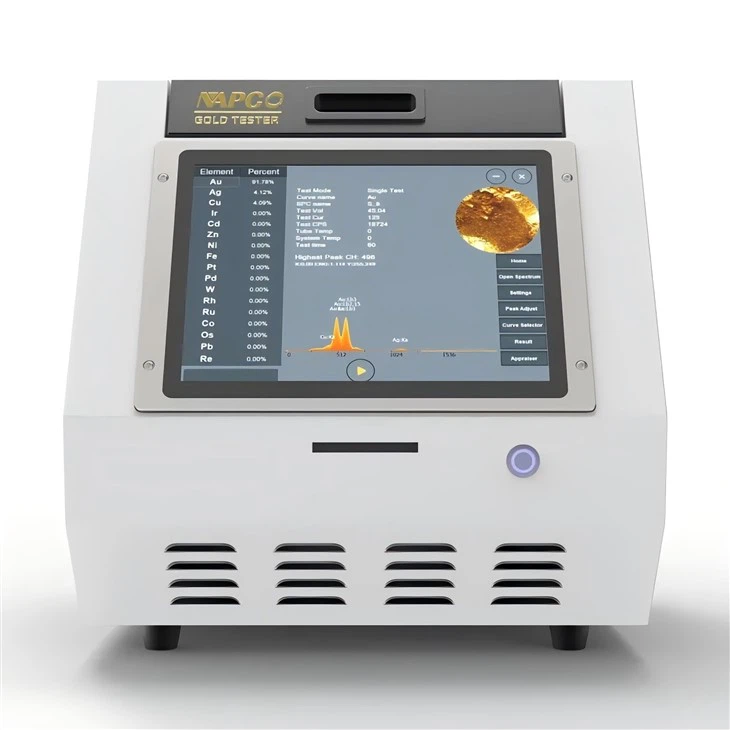
The NAP 8200E XRF Gold Tester is one of our flagship products. It features a wide dynamic range that can accurately measure gold concentrations from a few parts per million to near - 100% purity. This makes it ideal for a variety of applications, from analyzing gold in geological samples to verifying the purity of fine jewelry.
The N1 - 10 XRF Gold Tester is another reliable option. With a well - defined dynamic range, it offers precise measurements for both low - and high - grade gold samples. It is designed to be user - friendly, making it suitable for small - scale gold businesses or individual jewelers.
For more demanding industrial applications, the N1 - 25 XRF Gold Tester provides an extended dynamic range. It can handle large variations in gold concentrations, making it perfect for large - scale gold refineries and mining operations.
Conclusion
The dynamic range of a gold spectrometer is a fundamental characteristic that determines its performance and applicability in the gold analysis field. A wide dynamic range allows for more flexibility in sample types, better quality control, and overall more efficient gold analysis processes.
As a leading supplier of gold spectrometers, we are committed to providing our customers with instruments that offer excellent dynamic ranges and high - quality performance. Whether you are a gold miner, a jeweler, or a gold refinery operator, our range of gold spectrometers can meet your specific needs.
If you are interested in learning more about our gold spectrometers or would like to discuss your specific requirements for gold analysis, we encourage you to contact us for a detailed consultation. Our team of experts is ready to assist you in finding the most suitable gold spectrometer for your business.
References
- "X - Ray Fluorescence Spectrometry: Principles and Applications" by E. Pella. This book provides in - depth knowledge about the principles of XRF spectrometry, which is the underlying technology for many gold spectrometers.
- Journal articles on gold analysis techniques, which discuss the importance of dynamic range in accurate gold measurement. These articles can be found in scientific journals such as "Analytical Chemistry" and "Journal of Analytical Atomic Spectrometry".