


When it comes to the world of precious metals, gold often takes center stage. However, in the real market, gold is frequently mixed with other precious metals for various reasons, such as enhancing durability, changing color, or reducing costs. As a leading XRF testing gold supplier, we understand the significance and challenges of accurately analyzing gold mixed with other precious metals. In this blog, we will explore how XRF testing addresses this complex issue.
Understanding the Mixture of Gold with Other Precious Metals
Before delving into how XRF testing handles these mixtures, it is essential to understand the common combinations. Gold is often alloyed with silver, platinum, palladium, and copper. For example, white gold is typically a blend of gold and silver, palladium, or nickel, which gives it a distinct white color. Rose gold, on the other hand, contains a significant amount of copper, resulting in its characteristic pink hue.
These mixtures can vary widely in terms of composition ratios. A piece of jewelry might have a high - gold content, say 90%, with the remaining 10% split between silver and copper. Another item could have a more complex blend with lower gold percentages and multiple other precious metals. Determining the exact composition of these mixtures is critical for various industries, including jewelry manufacturing, precious metal trading, and recycling.
The Basics of XRF Testing
XRF, or X - Ray Fluorescence, is a non - destructive analytical technique used to determine the elemental composition of a sample. In the context of gold mixed with other precious metals, XRF testing works by emitting X - rays onto the sample. When the X - rays hit the atoms in the sample, they cause inner - shell electrons to be ejected. To fill the void left by the ejected electrons, outer - shell electrons drop down, releasing energy in the form of fluorescent X - rays.
The energy of these fluorescent X - rays is unique for each element. By measuring the energy and intensity of the emitted fluorescent X - rays, an XRF spectrometer can identify the elements present in the sample and quantify their concentrations. This process is fast, usually taking just a few seconds to a few minutes, and it does not damage the sample, making it ideal for valuable precious metal items.
How XRF Testing Handles Gold - Precious Metal Mixtures
Element Identification
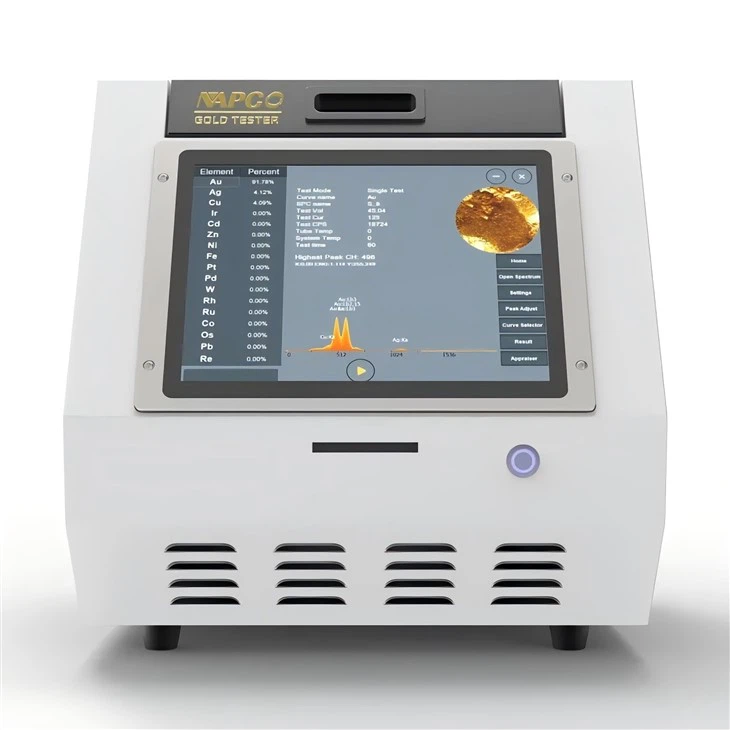
One of the primary ways XRF testing manages gold mixed with other precious metals is through accurate element identification. Our state - of - the - art XRF gold testers, such as the N1 - 10 XRF Gold Tester, are equipped to detect a wide range of elements commonly found in gold alloys. They can easily differentiate between gold, silver, platinum, palladium, copper, and other trace elements.
For instance, if a sample contains gold and silver, the XRF tester can clearly identify the presence of both elements based on the unique energy signatures of their fluorescent X - rays. This is crucial because the value of the sample is highly dependent on which elements are present. A gold - silver alloy may have a different market value compared to a gold - platinum alloy, even if the gold content is the same.
Concentration Measurement
Once the elements are identified, XRF testing can accurately measure their concentrations in the mixture. Our NAP 8200E XRF Gold Tester is designed to provide highly precise concentration measurements. It can determine the percentage of gold and other precious metals in the alloy with a high degree of accuracy.
In a gold - copper alloy, for example, the XRF tester can precisely measure how much gold and how much copper are present. This information is vital for jewelry manufacturers, who need to ensure that they are using the correct alloy compositions to meet quality standards. In the recycling industry, accurate concentration measurement helps determine the value of the scrap metal and the amount of pure gold that can be extracted.
Handling Complex Mixtures
Often, gold is mixed with multiple precious metals and other elements, creating complex mixtures. XRF testing is well - suited to handle these situations. Advanced algorithms and calibration techniques are used in our XRF spectrometers, such as the N1 - 25 XRF Gold Tester, to improve the accuracy of analysis in complex alloys.
These algorithms take into account the interactions between different elements in the sample. For example, when gold, silver, and platinum are all present, the presence of one element can affect the measurement of another. The algorithms in our XRF testers correct for these matrix effects, providing more accurate results even in the most complex mixtures.
Surface and Depth Analysis
In some cases, the composition of a gold - precious metal mixture may vary from the surface to the interior. XRF testing can provide information about both the surface and near - surface composition. By adjusting the intensity and penetration depth of the X - rays, our XRF testers can analyze different layers of the sample.
This is particularly important in situations where a thin layer of gold may be plated over a base metal or another gold - alloy core. The surface analysis can quickly determine if the sample is plated, and the depth analysis can help understand the composition of the underlying material. This helps in detecting counterfeit or misrepresented precious metal items.
Applications of XRF Testing for Gold - Precious Metal Mixtures
Jewelry Industry
In the jewelry industry, XRF testing is indispensable. Jewelry manufacturers use it to ensure the quality of their products. By accurately analyzing the gold - precious metal mixtures, they can meet the purity standards required by various markets. For example, in the United States, gold jewelry must meet certain karatage requirements, and XRF testing helps verify compliance.
Retailers also benefit from XRF testing. It allows them to provide accurate information to their customers about the composition of the jewelry they are selling, building trust and confidence in their products. Additionally, in the second - hand jewelry market, XRF testing helps determine the true value of used items.
Precious Metal Trading
Precious metal traders rely on XRF testing to assess the quality of the gold and other precious metal products they buy and sell. When dealing with large quantities of gold - precious metal mixtures, even a small error in composition analysis can result in significant financial losses. Our high - precision XRF testers provide the traders with the confidence they need to make informed decisions.
Recycling Industry
In the recycling industry, XRF testing plays a crucial role in maximizing the value of scrap precious metals. When recycling gold - precious metal mixtures, it is essential to know the exact composition of the scrap to determine the most efficient extraction methods. Our XRF testers help recycling facilities quickly and accurately analyze the incoming materials, enabling them to optimize their processes and increase profitability.
Conclusion
XRF testing is an invaluable tool for handling gold mixed with other precious metals. It offers accurate element identification, concentration measurement, and the ability to handle complex mixtures. Our range of XRF gold testers, including the N1 - 10 XRF Gold Tester, NAP 8200E XRF Gold Tester, and N1 - 25 XRF Gold Tester, are designed to meet the diverse needs of industries dealing with precious metals.
If you are in the jewelry industry, precious metal trading, or recycling, and are looking for reliable XRF testing solutions for gold - precious metal mixtures, we invite you to contact us. Our team of experts is ready to discuss your specific requirements and how our XRF gold testers can help you achieve your goals.

References
- Jenkins, R. (1999). X - Ray Fluorescence Spectrometry. John Wiley & Sons.
- Moseley, H. G. J. (1913). The high - frequency spectra of the elements. Philosophical Magazine, 26(156), 1024 - 1034.
- Van Grieken, R., & Markowicz, A. A. (2002). Handbook of X - ray spectrometry. Marcel Dekker.