


Hey there! As a supplier of gold spectrometers, I've been getting a lot of questions lately about how the signal processing algorithm of a gold spectrometer affects its accuracy. So, I thought I'd take a moment to break it down for you.
First off, let's talk about what a gold spectrometer does. Simply put, it's a device that analyzes the composition of gold and other precious metals. It works by emitting X-rays or other forms of radiation onto a sample, and then measuring the energy and intensity of the radiation that's reflected back. Based on these measurements, the spectrometer can determine the elemental composition of the sample, including the percentage of gold, silver, platinum, and other metals.
Now, here's where the signal processing algorithm comes in. The raw data that the spectrometer collects is just a bunch of numbers and signals. The signal processing algorithm is responsible for taking this raw data and turning it into meaningful information about the sample's composition. It does this by applying a series of mathematical calculations and statistical models to the data, in order to filter out noise, correct for background interference, and identify the characteristic peaks and patterns that correspond to different elements.
So, how does the quality of the signal processing algorithm affect the accuracy of the spectrometer? Well, it turns out that the algorithm plays a crucial role in determining the reliability and precision of the results. A good algorithm will be able to accurately identify and quantify the elements in the sample, even in the presence of complex matrices and interfering elements. It will also be able to provide consistent and reproducible results, which is essential for quality control and assurance in the gold industry.
On the other hand, a poor algorithm can lead to inaccurate and unreliable results. It may misinterpret the data, fail to detect certain elements, or provide inconsistent readings from one measurement to the next. This can have serious consequences for businesses that rely on accurate gold analysis, such as jewelry manufacturers, refineries, and pawn shops.
Let's take a closer look at some of the key factors that can affect the performance of the signal processing algorithm:
- Noise reduction: One of the biggest challenges in gold analysis is dealing with noise and interference in the data. The signal processing algorithm needs to be able to filter out this noise and extract the relevant signal from the background. This can be achieved through a variety of techniques, such as smoothing, filtering, and baseline correction.
- Peak identification and quantification: Another important task of the algorithm is to identify the characteristic peaks and patterns in the data that correspond to different elements. It then needs to accurately quantify the intensity of these peaks, in order to determine the concentration of each element in the sample. This requires sophisticated algorithms that can handle overlapping peaks and complex spectral profiles.
- Calibration and standardization: To ensure accurate and consistent results, the spectrometer needs to be calibrated and standardized using known reference materials. The signal processing algorithm plays a key role in this process, by applying the appropriate calibration factors and correction coefficients to the data. It also needs to be able to adapt to changes in the instrument's performance over time, in order to maintain its accuracy and precision.
- Matrix effects: The composition of the sample matrix can have a significant impact on the accuracy of the analysis. Different elements can interact with each other and with the sample matrix, causing spectral interference and matrix effects. The signal processing algorithm needs to be able to correct for these effects, in order to provide accurate results regardless of the sample matrix.
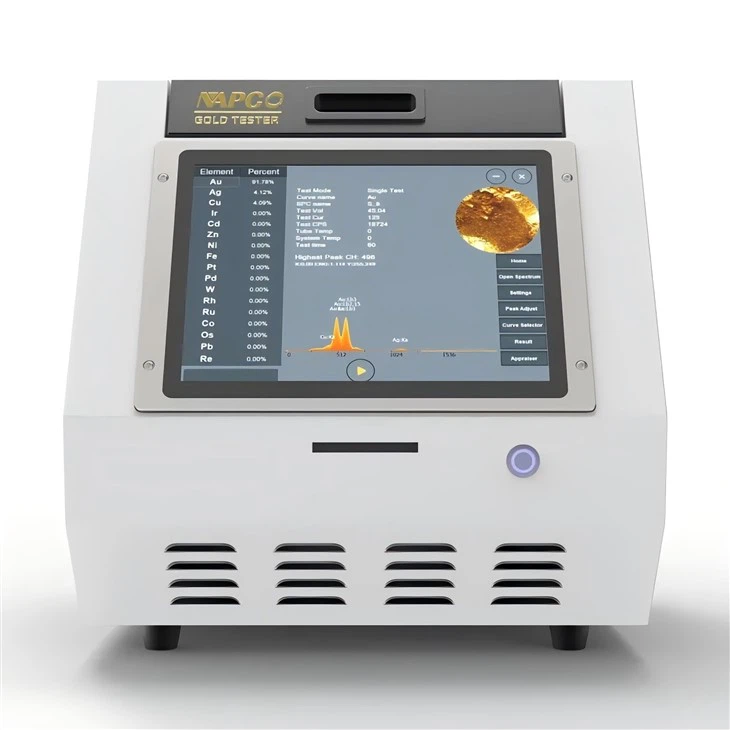
At our company, we understand the importance of having a high-quality signal processing algorithm in our gold spectrometers. That's why we've invested heavily in research and development, to ensure that our algorithms are state-of-the-art and able to provide the most accurate and reliable results possible. Our NAP 8200E XRF Gold Tester, N1 XRF Gold Tester, and NA 6500 XRF Gold Tester are all equipped with advanced signal processing algorithms that have been optimized for gold analysis. These algorithms are designed to provide fast, accurate, and non-destructive analysis of gold and other precious metals, making them ideal for a wide range of applications in the gold industry.
In addition to our advanced signal processing algorithms, we also offer a range of other features and benefits that set our gold spectrometers apart from the competition. For example, our spectrometers are easy to use and operate, with intuitive software interfaces that make it simple to analyze samples and interpret the results. They also offer high-resolution imaging and real-time data acquisition, which allows for more detailed and accurate analysis of the sample.
Another advantage of our gold spectrometers is their portability and versatility. Our handheld and benchtop models are designed to be lightweight and easy to transport, making them ideal for on-site analysis and fieldwork. They can also be used to analyze a wide range of sample types, including jewelry, coins, bars, and scrap gold.
So, if you're in the market for a high-quality gold spectrometer, look no further than our company. We offer a range of spectrometers that are designed to meet the needs of different customers and applications, and we're committed to providing the best possible customer service and support. Whether you're a jewelry manufacturer, a refinery, a pawn shop, or a gold investor, we have the right spectrometer for you.
If you're interested in learning more about our gold spectrometers or would like to schedule a demonstration, please don't hesitate to contact us. We'd be happy to answer any questions you may have and help you find the right spectrometer for your needs.

References:
- "X-ray Fluorescence Spectroscopy: Principles and Applications" by G. E. Langer and R. Jenkins
- "Handbook of X-ray Spectrometry" by C. S. Fadley and K. K. Murray
- "Introduction to Analytical Chemistry" by Douglas A. Skoog, F. James Holler, and Stanley R. Crouch