


Hey there! As a supplier of gold testers, I often get asked about how these nifty devices actually work. So, let's dive right in and explore the ins and outs of a chemical gold tester.
First off, why do we even need gold testers? Well, the gold market is huge, and there's a lot of fake or impure gold out there. Whether you're a jeweler, a pawnbroker, or just someone who wants to make sure that shiny piece you inherited is the real deal, a reliable gold tester is a must - have.
The Basics of Chemical Gold Testing
Chemical gold testers work based on some pretty cool chemistry principles. At the heart of it, these testers use acids to react with the metal in question. You see, different metals react differently to acids, and gold has a unique reaction pattern.
When you're testing gold, you're usually trying to determine its purity. Gold purity is measured in karats. 24 - karat gold is pure gold, while 18 - karat gold is 75% gold (because 18/24 = 0.75), and so on.
The most common acid used in chemical gold testing is nitric acid. Nitric acid is a strong oxidizing agent. When it comes into contact with base metals like copper, silver, or zinc (which are often mixed with gold in alloys), it will react with them. For example, copper will dissolve in nitric acid, producing a greenish - blue solution.
Here's how the process typically goes:
-
Prepare the sample: You need to make a small scratch on the gold item. This exposes the inner metal, so you're testing the actual composition, not just the surface plating. You can use a testing stone or a file to make this scratch.

-
Apply the acid: Using a dropper, you carefully apply a small amount of the testing acid to the scratch. Different acids are used for different karat levels. For instance, there are specific acids for testing 10 - karat, 14 - karat, and 18 - karat gold.
-
Observe the reaction: If the gold is pure or has a high karat value, it will resist the acid. The acid won't dissolve it or will only have a very minor effect. However, if there are a lot of base metals in the alloy, the acid will react with them, and you'll see a visible change. A rapid fizzing or a change in color indicates the presence of non - gold metals.
-
Compare the results: You can compare the reaction you see with a reference chart that shows what the reactions should look like for different karat levels. This helps you estimate the purity of the gold.
Advantages and Disadvantages of Chemical Gold Testing
Like any testing method, chemical gold testing has its pros and cons.
Advantages:
- Cost - effective: Chemical gold testing kits are relatively inexpensive. You can buy a basic kit for a few dollars, which makes it accessible for small businesses and individual users.
- Portable: You can carry these kits around easily. Whether you're at a trade show, a flea market, or just testing something at home, you can have a chemical gold tester on hand.
Disadvantages:
- Destructive: Making a scratch on the gold item is irreversible. This means you can't test valuable or antique pieces without causing some damage.
- Limited accuracy: Chemical testing can give you a general idea of the gold's purity, but it's not as accurate as some other methods. There can be some subjectivity in interpreting the reactions, and it might not detect very small amounts of impurities.
XRF Gold Testers: A Modern Alternative
While chemical gold testing has been around for a long time, there's a newer and more advanced technology on the scene: XRF (X - Ray Fluorescence) gold testers. As a supplier, I'm particularly excited about these devices, and I'll tell you why.
XRF gold testers work on a completely different principle. Instead of using acids, they use X - rays. When an XRF gold tester is pointed at a gold item, it emits a beam of X - rays. These X - rays interact with the atoms in the metal.
Here's a more detailed look at how XRF gold testers function:
-
X - ray emission: The XRF tester has an X - ray tube that generates X - rays. These X - rays are directed towards the sample.
-
Interaction with atoms: When the X - rays hit the atoms in the gold item, they cause the electrons in the atoms to become excited. As these electrons return to their normal energy levels, they emit secondary X - rays, which are called fluorescent X - rays.
-
Detection and analysis: The XRF tester has a detector that measures the energy and intensity of the fluorescent X - rays. Different elements emit fluorescent X - rays at specific energies. By analyzing these energies, the tester can determine which elements are present in the sample and in what quantities.
-
Purity calculation: Based on the elemental composition, the XRF tester can calculate the gold's purity. It can also identify other elements in the alloy, such as copper, silver, or palladium.
Benefits of XRF Gold Testers
- Non - destructive: Unlike chemical testing, XRF testing doesn't require making a scratch on the gold item. This makes it ideal for testing valuable or delicate pieces.
- High accuracy: XRF testers can provide very accurate results, often with a precision of up to 0.1%. This is much more accurate than chemical testing.
- Fast results: You can get the results in a matter of seconds. This is great for businesses that need to test a large number of items quickly.
Our XRF Gold Testers
As a supplier, we offer a range of high - quality XRF gold testers. For example, the NA 6500 XRF Gold Tester is a benchtop model that's perfect for professional jewelers and pawnbrokers. It has a large sample chamber and can handle a variety of sample sizes.
The NAP 8200E XRF Gold Tester is another great option. It's known for its user - friendly interface and high - speed analysis. Whether you're a beginner or an experienced user, you'll find this tester easy to operate.
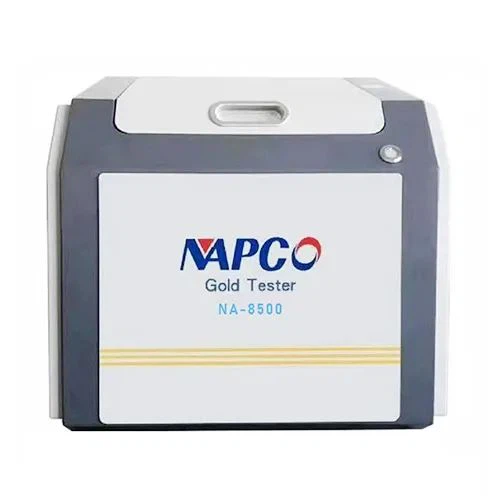
And if you're looking for a top - of - the - line model, check out the NA 8500 XRF Gold Tester. This tester offers the latest technology and the highest level of accuracy. It's suitable for large - scale gold testing operations.
Conclusion
So, there you have it! That's how chemical gold testers work, and how XRF gold testers are changing the game. Whether you're a professional in the gold industry or just someone who wants to test a piece of gold at home, there's a testing solution for you.
If you're interested in purchasing a gold tester for your business or personal use, don't hesitate to reach out. We're here to help you find the right product for your needs and ensure that you get accurate and reliable results.
References
- "Gold Testing Methods" - Journal of Precious Metals Science
- "X - Ray Fluorescence Spectroscopy: Principles and Applications" - Elsevier