


Gold, a precious metal that has captivated humanity for millennia, holds significant value in various industries, from jewelry to electronics. As a benchtop gold tester supplier, we understand the importance of accurate and reliable testing, especially when dealing with gold items that may have surface scratches. In this blog post, we will explore how our benchtop gold testers handle gold with surface scratches and ensure precise results.
Understanding the Impact of Surface Scratches on Gold Testing
Surface scratches on gold can potentially affect the accuracy of gold testing. These scratches can expose underlying layers of the metal, which may have different compositions than the surface layer. For instance, if the gold item is plated or has impurities near the surface, scratches can allow the testing equipment to detect these variations, leading to inaccurate readings. Additionally, scratches can trap dirt, debris, or other contaminants, which can also interfere with the testing process.
How Our Benchtop Gold Testers Overcome Scratch Challenges
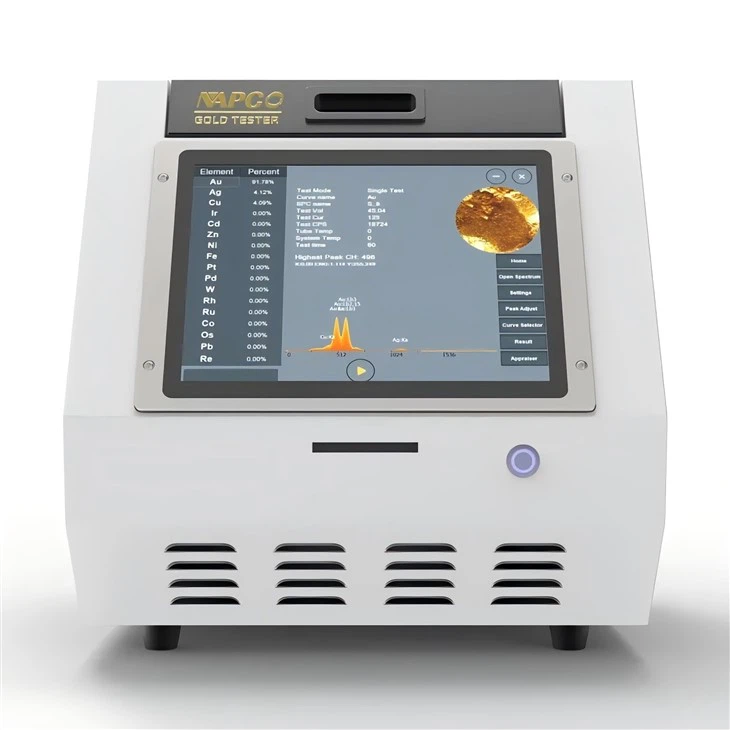
Our benchtop gold testers, such as the NA 6500 XRF Gold Tester, N1 XRF Gold Tester, and NAP 8200E XRF Gold Tester, are equipped with advanced technology that enables them to handle gold with surface scratches effectively. Here's how:
1. X-ray Fluorescence (XRF) Technology
XRF technology is at the core of our benchtop gold testers. This non-destructive testing method works by emitting X-rays onto the gold sample. When the X-rays interact with the atoms in the gold, they cause the atoms to emit secondary X-rays, known as fluorescent X-rays. The energy and intensity of these fluorescent X-rays are characteristic of the elements present in the sample. By analyzing these X-rays, our testers can accurately determine the elemental composition of the gold, including its purity and the presence of other elements.
The advantage of XRF technology is that it can penetrate the surface layer of the gold and analyze the underlying material. Even if the surface is scratched, the X-rays can still reach the deeper layers of the gold, providing a more comprehensive analysis of the entire sample. This helps to minimize the impact of surface scratches on the test results.
2. Multiple Point Testing
To further enhance the accuracy of the testing, our benchtop gold testers are capable of performing multiple point testing. Instead of relying on a single measurement, the tester takes readings from several different points on the gold sample. This approach helps to account for any variations in the composition of the gold due to surface scratches or other factors. By averaging the results from multiple points, the tester can provide a more representative and accurate assessment of the gold's purity.
3. Advanced Software Algorithms
Our gold testers are equipped with advanced software algorithms that are designed to filter out any interference caused by surface scratches or contaminants. These algorithms analyze the raw data collected by the tester and apply sophisticated mathematical models to correct for any anomalies. For example, the software can identify and ignore any signals that are likely to be due to dirt or debris on the surface of the gold, ensuring that the test results are based solely on the composition of the gold itself.
Preparing Gold with Surface Scratches for Testing
While our benchtop gold testers are capable of handling gold with surface scratches, it is still recommended to prepare the sample before testing to ensure the most accurate results. Here are some steps you can take:
1. Clean the Gold
Use a mild detergent and a soft brush to clean the gold sample. This will remove any dirt, debris, or contaminants that may be present on the surface, including those trapped in the scratches. Rinse the gold thoroughly with water and dry it completely before testing.
2. Remove Loose Particles
If there are any loose particles or flakes on the surface of the gold, gently remove them using a pair of tweezers or a soft cloth. This will prevent these particles from interfering with the testing process.
3. Avoid Over-Polishing
While it may be tempting to polish the gold to remove the scratches, this can actually affect the accuracy of the test results. Polishing can remove a thin layer of the gold, which may change the composition of the surface and lead to inaccurate readings. Instead, leave the scratches as they are and let our benchtop gold testers do their job.
Real-World Applications and Case Studies
To illustrate the effectiveness of our benchtop gold testers in handling gold with surface scratches, let's look at some real-world applications and case studies.
1. Jewelry Testing
In the jewelry industry, it is common for gold items to have surface scratches due to normal wear and tear. Our benchtop gold testers have been used by jewelry manufacturers, retailers, and appraisers to accurately test the purity of gold jewelry with surface scratches. For example, a jewelry store received a vintage gold necklace with several surface scratches. Using our NA 6500 XRF Gold Tester, the store was able to determine the exact purity of the gold, allowing them to price the necklace accurately and provide their customers with a reliable appraisal.
2. Gold Recycling
In the gold recycling industry, gold items often come in various conditions, including those with surface scratches. Our benchtop gold testers are used by gold recyclers to quickly and accurately determine the value of the gold before recycling. For instance, a gold recycling company received a batch of gold coins with surface scratches. By using our N1 XRF Gold Tester, the company was able to assess the purity of the coins and offer a fair price to the seller.
Conclusion
In conclusion, our benchtop gold testers are designed to handle gold with surface scratches effectively, providing accurate and reliable test results. With advanced XRF technology, multiple point testing, and sophisticated software algorithms, our testers can overcome the challenges posed by surface scratches and ensure that you get a precise assessment of the gold's purity.
Whether you are in the jewelry industry, gold recycling business, or any other field that requires accurate gold testing, our benchtop gold testers are the ideal solution. If you are interested in learning more about our products or would like to discuss your specific testing needs, please do not hesitate to contact us. We look forward to working with you to provide the best gold testing solutions for your business.

References
- X-ray Fluorescence Spectroscopy: Principles and Applications. John Wiley & Sons, Inc.
- Handbook of Gold Analysis. CRC Press.