


Can XRF testing be used on gold - plated items?
Hey there! I'm from a company that supplies XRF testing equipment for gold. You might be wondering if XRF testing can be used on gold - plated items. Well, let's dig into this topic.
First off, what is XRF testing? XRF stands for X - ray fluorescence. It's a non - destructive analytical technique that can determine the elemental composition of a sample. When it comes to gold testing, XRF testers can quickly tell you the purity of gold in a piece, like whether it's 14K, 18K, or 24K.
Now, let's talk about gold - plated items. Gold - plated stuff is basically a base metal (like copper, silver, or brass) with a thin layer of gold on the surface. The thickness of this gold layer can vary a lot, from just a few microns to a bit thicker.
So, can XRF testing work on these gold - plated items? The short answer is yes, but with some limitations.
XRF testers work by sending X - rays into the sample. When these X - rays hit the atoms in the sample, they cause the atoms to emit secondary X - rays. By analyzing the energy of these secondary X - rays, the tester can figure out what elements are in the sample and how much of each there is.
For gold - plated items, the XRF tester will mainly detect the gold on the surface. If the gold layer is thick enough, the tester can give a relatively accurate reading of the gold purity in that surface layer. However, it can't tell you what's going on beneath that gold layer. If the base metal is also detected, it might give a false impression of the overall purity if you're not careful.
Let's say you have a piece that's copper plated with a thin layer of 18K gold. The XRF tester will pick up the 18K gold on the surface, but it won't be able to accurately tell you about the copper beneath. If you assume that the whole piece is 18K gold based on the XRF reading, you're in for a surprise when you look closer.
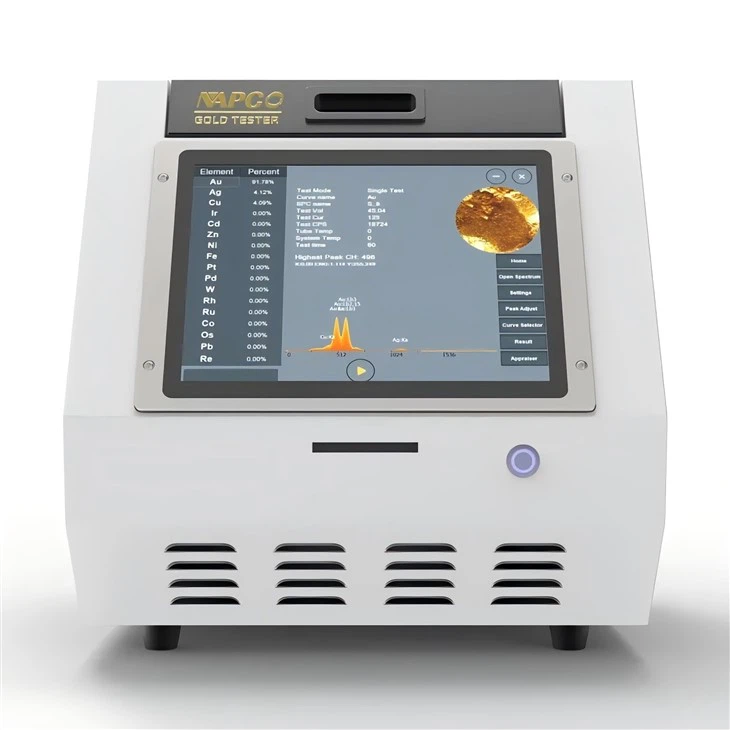
The accuracy of XRF testing on gold - plated items also depends on the quality of the tester. At our company, we offer some great XRF gold testers. For example, the N1 XRF Gold Tester is a really reliable option. It's designed to give accurate readings quickly, even on complex samples like gold - plated items. It has advanced technology that can help distinguish between the surface gold layer and the base metal to some extent.
Another great option is the NAP 8200E XRF Gold Tester. This tester is known for its high precision and user - friendly interface. It can handle different types of gold - plated items and give you a detailed analysis of the surface elements.
And then there's the NA 8500 XRF Gold Tester. It's a top - of - the - line model with enhanced features. It can detect even very thin gold layers and provide accurate information about the elemental composition.
One thing to keep in mind is that when using an XRF tester on gold - plated items, you need to be aware of the limitations. You can't just rely on the XRF reading as the final word. It's a good starting point, but you might need to use other methods to get a more complete picture. For example, you could do a scratch test (although this is destructive) or use an acid test in combination with the XRF test.
If you're in the business of dealing with gold - plated items, having an XRF tester can still be really useful. It can help you quickly screen items and get an idea of the surface gold purity. This can save you a lot of time compared to other more time - consuming testing methods.
Let's talk a bit more about the benefits of using XRF testing for gold - plated items.
Firstly, it's non - destructive. You don't have to damage the item to test it. This is really important if you're dealing with valuable or antique pieces. You can test them without ruining them.
Secondly, it's fast. You can get a result in just a few seconds or minutes, depending on the tester. This is great if you have a lot of items to test.
Thirdly, it's relatively easy to use. Most of our XRF testers, like the N1 XRF Gold Tester, have simple interfaces that even someone with little technical knowledge can operate.
However, as I mentioned before, you need to be careful when interpreting the results. You should always take into account the possibility of a base metal beneath the gold layer.
If you're thinking about buying an XRF tester for testing gold - plated items, there are a few things to consider.
The first is the detection limit. You want a tester that can detect even very thin gold layers. Our NA 8500 XRF Gold Tester is great in this regard. It has a high - sensitivity detector that can pick up small amounts of gold.
The second is the accuracy of the elemental analysis. You need a tester that can accurately distinguish between different elements, especially when dealing with complex samples like gold - plated items. The NAP 8200E XRF Gold Tester is known for its accurate elemental analysis.
The third is the cost. Of course, you want a good - quality tester, but you also don't want to break the bank. We offer a range of testers at different price points, so you can find one that fits your budget.
In conclusion, XRF testing can be a valuable tool for testing gold - plated items, but it has its limitations. It can give you a good idea of the surface gold purity, but you need to be cautious when interpreting the results. At our company, we have some great XRF testers, like the N1 XRF Gold Tester, NAP 8200E XRF Gold Tester, and NA 8500 XRF Gold Tester, that can help you with your gold - plating testing needs.
If you're interested in learning more about our XRF testers or want to discuss your specific requirements, don't hesitate to reach out. We're here to help you make the right choice for your business.

References:
- "X - Ray Fluorescence Spectroscopy: Principles and Applications"
- Industry reports on gold testing methods