


X-ray fluorescence (XRF) testing has become a widely recognized and reliable method for analyzing the elemental composition of various materials, including precious metals like gold. As a leading supplier of XRF gold testing equipment, I often receive inquiries about the applicability of XRF testing on gold dental fillings. In this blog post, I'll delve into the details of whether XRF testing can be used on gold dental fillings, exploring the technology, its advantages, limitations, and considerations.
Understanding XRF Testing
XRF testing is a non-destructive analytical technique that uses X-rays to determine the elemental composition of a sample. When an X-ray beam is directed at a sample, the atoms in the sample absorb the X-rays and then emit secondary X-rays, known as fluorescent X-rays. The energy and intensity of these fluorescent X-rays are characteristic of the elements present in the sample. By analyzing these X-rays, an XRF analyzer can identify and quantify the elements in the sample.
XRF Testing and Gold Dental Fillings
Gold has been used in dentistry for centuries due to its biocompatibility, durability, and resistance to corrosion. Gold dental fillings typically contain a mixture of gold, along with other metals such as silver, copper, palladium, and platinum. These alloying elements are added to improve the mechanical properties of the gold, such as hardness and strength.
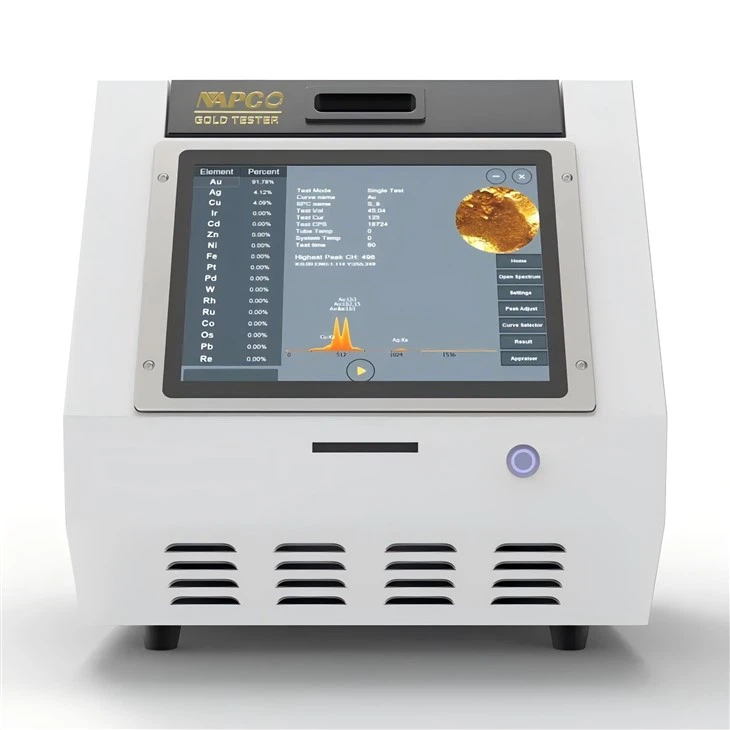
XRF testing can indeed be used on gold dental fillings to determine their elemental composition and gold purity. Our NAP 8200E XRF Gold Tester, NA 6500 XRF Gold Tester, and N1 XRF Gold Tester are specifically designed to accurately analyze the elemental composition of gold and other precious metals. These testers can quickly and non-destructively provide information about the gold content, as well as the presence and concentration of other alloying elements in the dental filling.

Advantages of XRF Testing on Gold Dental Fillings
- Non-destructive: One of the most significant advantages of XRF testing is that it is non-destructive. This means that the dental filling can be analyzed without causing any damage to it. This is particularly important in the context of dental fillings, as they are often valuable and may need to be reused or repurposed.
- Fast and accurate: XRF testing can provide results in a matter of seconds to minutes, depending on the complexity of the sample and the specific analyzer used. Our XRF gold testers are highly accurate, with a precision of up to 0.1% for gold purity determination.
- Multi-element analysis: XRF testing can simultaneously detect and quantify multiple elements in the dental filling. This allows for a comprehensive analysis of the alloy composition, which can be useful for quality control, authentication, and research purposes.
- Portable and easy to use: Many XRF analyzers, including our models, are portable and easy to operate. This makes them suitable for use in a variety of settings, such as dental laboratories, jewelry stores, and research facilities.
Limitations of XRF Testing on Gold Dental Fillings
- Surface analysis: XRF testing is primarily a surface analysis technique. It can only provide information about the elemental composition of the outer layer of the dental filling, typically up to a depth of a few micrometers. If the dental filling has a heterogeneous composition or if there are inclusions or contaminants below the surface, the XRF results may not accurately represent the overall composition of the filling.
- Matrix effects: The presence of other elements in the dental filling can affect the accuracy of the XRF analysis. This is known as the matrix effect. For example, the presence of high concentrations of certain elements may interfere with the detection and quantification of other elements. To minimize matrix effects, it is important to use appropriate calibration standards and correction algorithms.
- Limit of detection: XRF analyzers have a limit of detection for each element, which means that they may not be able to detect elements present in very low concentrations. This can be a limitation when analyzing dental fillings that contain trace amounts of certain elements.
Considerations for XRF Testing on Gold Dental Fillings
- Sample preparation: Proper sample preparation is essential for accurate XRF analysis. The dental filling should be clean and free of any contaminants, such as saliva, plaque, or dental cement. It may be necessary to polish the surface of the filling to ensure a smooth and flat surface for analysis.
- Calibration: To obtain accurate results, the XRF analyzer must be properly calibrated using appropriate standards. Our XRF gold testers come with pre-calibrated curves for gold and other precious metals, but it is still important to regularly verify and adjust the calibration as needed.
- Interpretation of results: The interpretation of XRF results requires some knowledge and expertise. It is important to understand the limitations of the technique and to consider other factors, such as the manufacturing process and the intended use of the dental filling, when interpreting the results.
Conclusion
In conclusion, XRF testing can be a valuable tool for analyzing the elemental composition and gold purity of gold dental fillings. It offers several advantages, including non-destructive analysis, fast and accurate results, multi-element analysis, and portability. However, it also has some limitations, such as surface analysis, matrix effects, and a limit of detection. By considering these factors and following proper sample preparation and calibration procedures, XRF testing can provide reliable and useful information about gold dental fillings.
If you are interested in purchasing an XRF gold tester for your dental laboratory, jewelry store, or research facility, or if you have any questions about XRF testing on gold dental fillings, please feel free to contact us. Our team of experts is available to provide you with more information and to help you choose the right XRF analyzer for your needs.
References
- Ewing, R. C., & Vance, E. R. (2007). X-ray fluorescence spectrometry. In Encyclopedia of Analytical Chemistry (pp. 10857-10876). John Wiley & Sons, Ltd.
- Jenkins, R. (1999). X-ray fluorescence spectrometry. New York: Wiley.
- Potts, P. J., & Webb, P. C. (2018). Principles and practice of X-ray fluorescence analysis. Cambridge University Press.