


As a supplier of XRF gold testing equipment, I often encounter questions from clients about the capabilities and limitations of XRF testing. One common query is whether XRF tests can be effectively used on gold - plated plastics. In this blog post, I'll delve into the science behind XRF testing, its applicability to gold - plated plastics, and how our XRF gold testers can play a role in this process.

Understanding XRF Testing
XRF, or X - Ray Fluorescence, is a non - destructive analytical technique used to determine the elemental composition of a sample. When an X - ray beam is directed at a sample, the atoms in the sample absorb the X - rays and then emit secondary X - rays, known as fluorescent X - rays. The energy of these fluorescent X - rays is characteristic of the elements present in the sample. By measuring the energy and intensity of these fluorescent X - rays, an XRF analyzer can identify and quantify the elements in the sample.
XRF testing has several advantages. It is fast, usually providing results within seconds to minutes. It is non - destructive, which means the sample remains intact after testing, making it suitable for valuable or irreplaceable items. It can also detect a wide range of elements, from light elements like magnesium to heavy elements like lead.
Gold - plated Plastics: A Complex Sample
Gold - plated plastics are items where a thin layer of gold is deposited on a plastic substrate. The gold layer can vary in thickness, and the plastic substrate can be made of different types of polymers. The main challenge with using XRF on gold - plated plastics lies in the fact that XRF analyzes the elemental composition of a certain depth within the sample.
The penetration depth of X - rays in a sample depends on the energy of the X - rays and the density of the material. In the case of gold - plated plastics, if the X - rays penetrate through the thin gold layer and reach the plastic substrate, the XRF analyzer will detect the elements in the plastic as well as those in the gold layer. This can complicate the analysis and make it difficult to accurately determine the purity and thickness of the gold layer.
Can XRF Test Gold - plated Plastics?
The answer is yes, but with some limitations. XRF can detect the presence of gold in gold - plated plastics. If the gold layer is thick enough, the XRF analyzer can provide a reasonably accurate measurement of the gold content in the layer. However, if the gold layer is extremely thin, the X - rays may penetrate through it, and the results may be influenced by the elements in the plastic substrate.
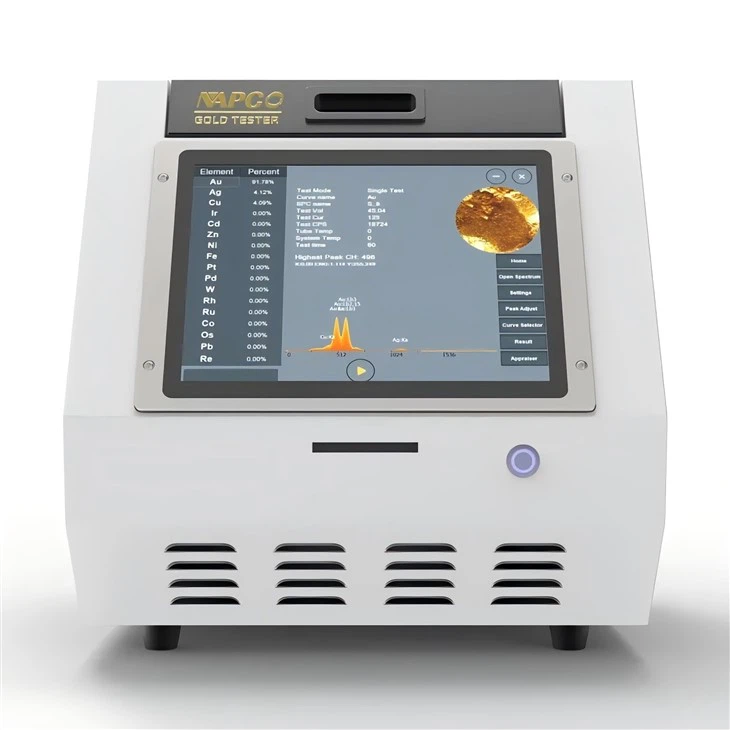
To get reliable results when testing gold - plated plastics, it is important to use an XRF analyzer with the appropriate settings. Some modern XRF analyzers, such as the N1 XRF Gold Tester, NAP 8200E XRF Gold Tester, and NA 8500 XRF Gold Tester, offer advanced features that can help in analyzing complex samples like gold - plated plastics.
These testers can be adjusted to use lower - energy X - rays, which have a shallower penetration depth. By using lower - energy X - rays, the analyzer can focus on the gold layer and reduce the influence of the plastic substrate. Additionally, some XRF analyzers come with software that can correct for the contribution of the substrate elements, improving the accuracy of the gold measurement.
Factors Affecting XRF Testing of Gold - plated Plastics
Gold Layer Thickness
As mentioned earlier, the thickness of the gold layer is a crucial factor. A thicker gold layer is more likely to give accurate results as the X - rays are less likely to penetrate through it. If the gold layer is too thin, the XRF analyzer may not be able to distinguish the gold from the plastic substrate accurately.
Plastic Substrate Composition
The type of plastic used as the substrate can also affect the XRF analysis. Different plastics contain different elements, and some elements may interfere with the detection of gold. For example, if the plastic contains elements with similar X - ray energies as gold, it can be challenging to separate the signals and accurately measure the gold content.
Surface Condition
The surface condition of the gold - plated plastic can impact the XRF results. A rough or uneven surface can scatter the X - rays, leading to inconsistent results. It is important to ensure that the surface of the sample is clean and smooth before testing.
Our XRF Gold Testers for Gold - plated Plastics
At our company, we offer a range of XRF gold testers that are well - suited for testing gold - plated plastics. The N1 XRF Gold Tester is a compact and portable analyzer that offers high - performance testing. It can be easily adjusted to different energy levels, allowing for precise analysis of thin gold layers on plastics.
The NAP 8200E XRF Gold Tester is a benchtop model with advanced software features. It can correct for substrate interference and provide accurate results even for complex samples. The NA 8500 XRF Gold Tester is another powerful option, offering high - speed analysis and excellent sensitivity.
Conclusion
In conclusion, XRF testing can be used on gold - plated plastics, but it requires careful consideration of the sample characteristics and the appropriate use of XRF equipment. Our XRF gold testers are designed to overcome the challenges associated with testing gold - plated plastics and provide accurate and reliable results.
If you are involved in the gold - plating industry or need to test gold - plated plastics for quality control or other purposes, we encourage you to reach out to us. Our team of experts can provide you with detailed information about our XRF gold testers and help you choose the right model for your specific needs. We are committed to providing high - quality testing solutions and excellent customer service. Contact us today to start a discussion about your XRF testing requirements.
References
- Bertin, E. P. (1975). Principles and practice of X - ray spectrometry. Plenum Press.
- Jenkins, R., Gould, R. W., & Gedcke, D. (1981). Quantitative X - ray spectrometry. Marcel Dekker.
- Van Grieken, R., & Markowicz, A. A. (2002). Handbook of X - ray spectrometry. Marcel Dekker.