




Can a gold spectrometer be used to test gold in solar panels?
Solar energy has emerged as a leading renewable energy source in recent years, with solar panels being the primary technology for harnessing this energy. As solar panel technology evolves, the materials used in their construction have also become more diverse and complex. One question that often arises is whether a gold spectrometer can be used to test for gold in solar panels. As a gold spectrometer supplier, I am well - positioned to explore this topic in depth.
The Role of Gold in Solar Panels
Gold is a highly conductive and corrosion - resistant metal. In solar panels, gold can be used in various components. For example, it can be used in the electrical contacts and interconnects within the solar cells. These contacts need to have low electrical resistance to ensure efficient transfer of the electricity generated by the solar cells. Gold's excellent conductivity makes it an ideal material for this purpose. Additionally, its high resistance to corrosion helps to maintain the long - term performance of the solar panels in different environmental conditions.
How Gold Spectrometers Work
A gold spectrometer typically uses X - ray fluorescence (XRF) technology. XRF spectrometers work by directing a beam of X - rays at the sample being tested. When the X - rays interact with the atoms in the sample, they cause the inner - shell electrons of the atoms to be ejected. When outer - shell electrons fill the resulting vacancies, characteristic X - rays are emitted. The energies of these characteristic X - rays are unique to each element, allowing the spectrometer to identify and quantify the elements present in the sample.
Testing Gold in Solar Panels with a Gold Spectrometer
When it comes to testing for gold in solar panels using a gold spectrometer, there are several factors to consider.
Sensitivity and Detection Limits
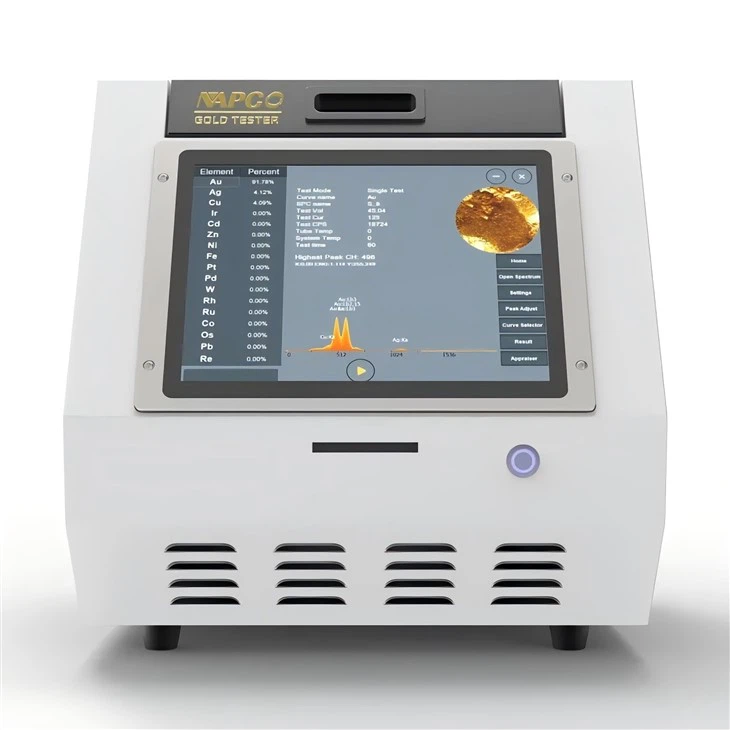
Gold spectrometers are generally designed to detect gold in a variety of samples, including jewelry, bullion, and alloys. However, the amount of gold in solar panels is often very small. Most solar panels contain only trace amounts of gold, usually in the form of thin layers or minute particles. High - quality gold spectrometers, such as the NAP 8200E XRF Gold Tester, are capable of detecting very low concentrations of elements. These spectrometers have a high level of sensitivity, which allows them to accurately detect the small amounts of gold that may be present in solar panels.
Sample Preparation
Proper sample preparation is crucial for accurate testing. Solar panels are complex devices composed of multiple layers and materials, such as silicon wafers, glass, and plastics. To test for gold, the sample may need to be carefully prepared to expose the areas where gold is likely to be present. This could involve removing the outer layers of the solar panel or taking small samples from the electrical contacts. The N1 - 10 XRF Gold Tester is equipped with advanced sample handling features that can accommodate different sample preparation methods and ensure reliable testing results.

Interference from Other Elements
Solar panels may contain a wide range of other elements, such as silicon, aluminum, and copper. These elements can potentially interfere with the detection of gold. The characteristic X - rays of some elements may overlap with those of gold, making it difficult to accurately measure the gold content. Modern gold spectrometers, like the N1 - 25 XRF Gold Tester, are equipped with advanced software algorithms that can compensate for these interferences. These algorithms analyze the X - ray spectra and separate the signals of different elements, allowing for accurate quantification of the gold content in the presence of other elements.
Applications of Gold Testing in Solar Panels
Quality Control in Manufacturing
For solar panel manufacturers, ensuring the quality and consistency of their products is of utmost importance. By using a gold spectrometer to test the gold content in the electrical contacts, manufacturers can verify that the correct amount of gold is being used. This helps to maintain the electrical performance and reliability of the solar panels. If the gold content is too low, the electrical resistance of the contacts may increase, leading to reduced efficiency. On the other hand, using too much gold may increase the production cost without providing significant additional benefits.
Recycling of Solar Panels
As the number of solar panels reaching the end of their life cycle increases, recycling has become an important issue. Gold is a valuable resource, and recovering it from solar panels can be economically viable. A gold spectrometer can be used to determine the gold content in different parts of the solar panel before the recycling process. This information helps recyclers to optimize their processes and maximize the recovery of valuable metals.
Contact for Purchase and Collaboration
If you are involved in the solar panel manufacturing or recycling industry and are interested in accurately testing the gold content in solar panels, our range of gold spectrometers can provide you with the solutions you need. Our gold spectrometers, including the NAP 8200E XRF Gold Tester, N1 - 10 XRF Gold Tester, and N1 - 25 XRF Gold Tester, are designed to offer high sensitivity, accurate results, and reliable performance. We invite you to contact us to discuss your specific requirements and explore how our products can benefit your business. Whether you need a benchtop model for laboratory testing or a portable device for on - site analysis, we have the right solution for you.
References
- X - ray Fluorescence Spectrometry: Principles and Applications, by Reeves, R.D.
- Handbook of Photovoltaic Science and Engineering, by Antonio Luque and Steven Hegedus.
- Solar Energy System Design and Integration, by William A. Beckman and J. Steven Krauter.