


Can a gold spectrometer be used to test gold in ceramic - based materials?
As a supplier of gold spectrometers, I often encounter various inquiries from customers about the capabilities and applications of our products. One question that has come up frequently is whether a gold spectrometer can be used to test gold in ceramic - based materials. In this blog post, I will delve into this topic and provide a comprehensive analysis.
Understanding Gold Spectrometers
Before we discuss the testing of gold in ceramic - based materials, let's first understand what a gold spectrometer is. A gold spectrometer, also known as an X - ray fluorescence (XRF) gold tester, is a device that uses X - ray fluorescence technology to analyze the elemental composition of a sample. It emits X - rays onto the sample, and when these X - rays interact with the atoms in the sample, they cause the atoms to emit secondary X - rays, known as fluorescent X - rays. The energy and intensity of these fluorescent X - rays are characteristic of the elements present in the sample, allowing the spectrometer to identify and quantify the elements.
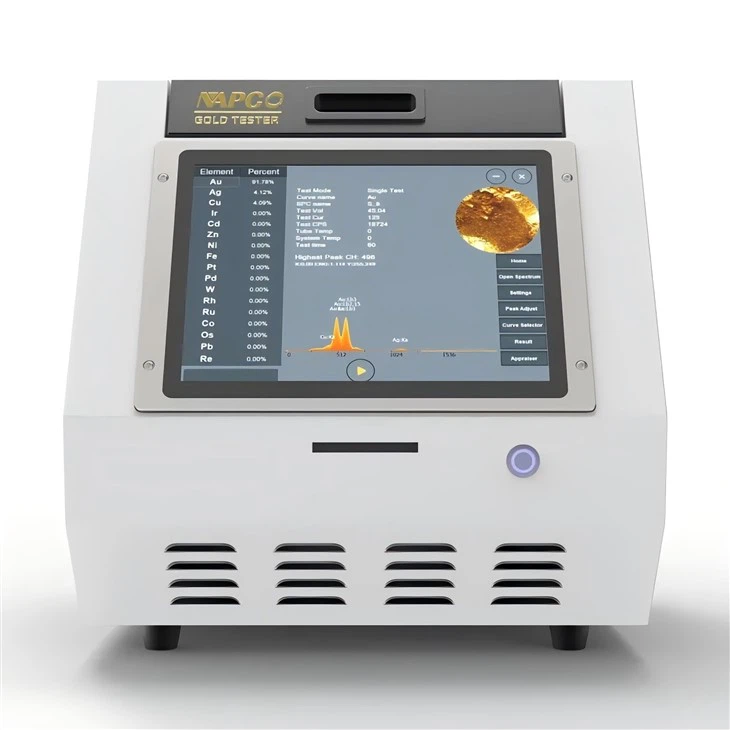
We offer a range of gold spectrometers, including the NA 6500 XRF Gold Tester, NAP 8200E XRF Gold Tester, and N1 XRF Gold Tester. These spectrometers are designed to provide accurate and reliable results for the analysis of gold and other precious metals.
Challenges of Testing Gold in Ceramic - Based Materials
Testing gold in ceramic - based materials presents several challenges. Firstly, ceramic materials are complex in composition. They typically contain a variety of elements such as silicon, aluminum, oxygen, and may also have other additives depending on their manufacturing process and intended use. These elements can interfere with the detection of gold. The X - ray fluorescence signals from the ceramic matrix elements may overlap with the signals from gold, making it difficult to accurately isolate and quantify the gold content.
Secondly, the distribution of gold in ceramic - based materials can be non - uniform. Gold may be present as small particles or inclusions within the ceramic matrix, and its concentration can vary significantly from one area to another. This non - uniformity requires careful sampling and analysis to ensure representative results.
Another challenge is the surface condition of the ceramic - based materials. Ceramics can have rough or porous surfaces, which can affect the X - ray penetration and the accuracy of the measurement. The X - rays may be scattered or absorbed by the surface irregularities, leading to inaccurate readings.
Possibilities and Limitations
Despite the challenges, a gold spectrometer can still be used to test gold in ceramic - based materials under certain conditions. Modern gold spectrometers are equipped with advanced algorithms and software that can help to minimize the interference from other elements. For example, they can use spectral de - convolution techniques to separate the overlapping X - ray fluorescence signals and accurately identify the gold peak.
If the gold content in the ceramic - based material is relatively high and the distribution is relatively uniform, the spectrometer can provide reasonably accurate results. However, for low - level gold detection, the accuracy may be compromised due to the background interference from the ceramic matrix.
It is also important to note that the type of gold spectrometer used matters. Some spectrometers with higher energy resolution and sensitivity are better suited for analyzing complex materials like ceramic - based materials. Our NA 6500 XRF Gold Tester is equipped with a high - performance detector and advanced signal processing capabilities, which can enhance the detection and quantification of gold in challenging samples.

Sample Preparation and Analysis Techniques
To improve the accuracy of testing gold in ceramic - based materials, proper sample preparation is crucial. The sample should be carefully ground and polished to obtain a smooth and flat surface. This helps to ensure consistent X - ray penetration and reduces the scattering effect. Additionally, multiple measurements can be taken from different areas of the sample to account for the non - uniformity of gold distribution.
Calibration is another important aspect. A set of calibration standards with known gold concentrations in a ceramic - like matrix should be used to calibrate the spectrometer. This allows the instrument to accurately convert the measured X - ray fluorescence signals into gold concentrations.
Applications and Use Cases
There are several applications where testing gold in ceramic - based materials is relevant. In the field of art and antiques, some ceramic artworks may have gold decorations or inlays. Analyzing the gold content can help to authenticate the piece and determine its value. In the electronics industry, ceramic substrates may contain gold for electrical conductivity purposes. Monitoring the gold content is important for quality control and cost management.
Conclusion
In conclusion, while there are challenges in using a gold spectrometer to test gold in ceramic - based materials, it is possible to obtain useful results with the right equipment, sample preparation, and analysis techniques. Our range of gold spectrometers, including the NA 6500 XRF Gold Tester, NAP 8200E XRF Gold Tester, and N1 XRF Gold Tester, are designed to handle complex materials and provide accurate elemental analysis.
If you are interested in testing gold in ceramic - based materials or have other needs related to gold analysis, we are here to help. Our team of experts can provide you with professional advice and support. Contact us to discuss your requirements and explore how our gold spectrometers can meet your needs.
References
- "X - Ray Fluorescence Spectrometry: Principles and Applications" by B. L. Henke
- "Elemental Analysis of Complex Materials Using XRF" by M. J. Reedy