


Yo, I'm in the business of supplying gold analyzer machines, and I often get asked, "Can a gold analyzer machine detect fake gold?" Well, let me break it down for you.

First off, there are different types of fake gold out there. Some fakes are just plain metals painted to look like gold. Others are alloys that mimic the appearance and some properties of gold but don't actually contain the real deal. And then there are those sneaky counterfeits that have a thin layer of real gold over a base metal.
So, can our gold analyzer machines tell these fakes from the real thing? You bet they can!
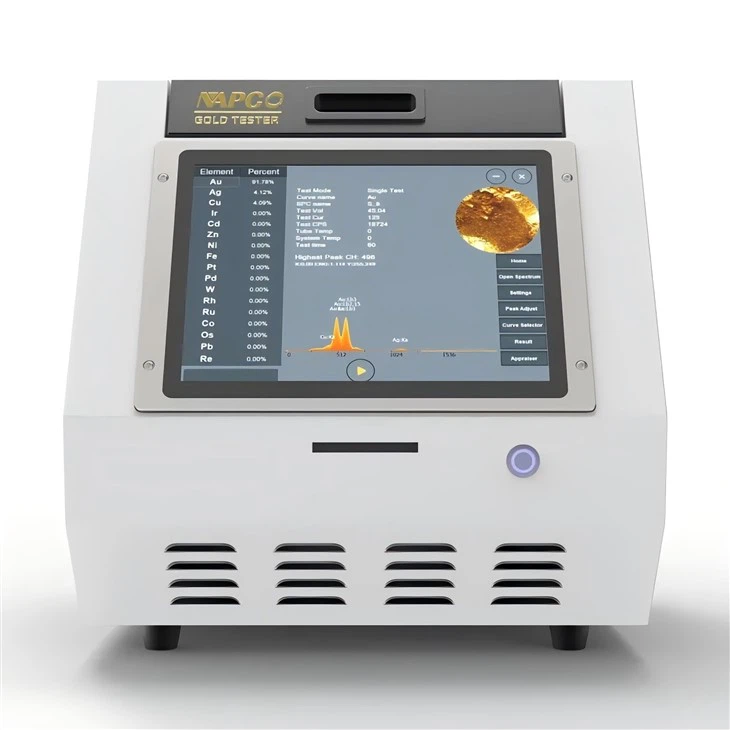
Let's talk about how these machines work. Most of the gold analyzer machines we supply, like the NAP 8200E XRF Gold Tester, use X-ray fluorescence (XRF) technology. This tech is pretty amazing. It sends X-rays into the sample of gold. When these X-rays hit the atoms in the sample, they cause the atoms to emit secondary X-rays. The energy and intensity of these secondary X-rays are unique to each element. So, by analyzing these secondary X-rays, the machine can figure out what elements are in the sample.
If it's pure gold, the machine will detect a high percentage of gold and very little of other elements. But if it's fake gold, it'll show a different elemental profile. For example, if it's a base metal painted with gold, the machine will detect mostly the elements of the base metal, like copper or zinc, and only a tiny amount of gold on the surface.
The N1 XRF Gold Tester is another great option. It's super accurate and can analyze the composition of the gold sample in just a few seconds. This is really useful when you're dealing with a lot of samples. You don't have to wait around for hours to find out if the gold is real or not.
Another machine in our lineup is the NA 6500 XRF Gold Tester. It's a bit more advanced and can detect even the smallest traces of impurities in the gold. This is crucial because some fakes are made to be very similar to real gold, and only a highly sensitive machine like this can tell them apart.
But it's not just about detecting fake gold. These machines can also give you an accurate reading of the purity of real gold. They can tell you if it's 10K, 14K, 18K, or 24K gold. This is important for jewelers, gold dealers, and anyone in the gold industry. You need to know the exact purity of the gold you're buying or selling.
Now, I know some people might be thinking, "Well, can't the counterfeiters just make better fakes that these machines can't detect?" It's true that counterfeiters are always trying to get better at what they do. But our machines are constantly being updated and improved. We work with scientists and engineers to make sure our machines can keep up with the latest counterfeiting techniques.
For example, some counterfeiters are starting to use more sophisticated alloys that are very close in composition to real gold. But our machines can still tell the difference because they can detect the subtle differences in the elemental makeup of these alloys.
Another thing to consider is the depth of analysis. Some fakes have a thin layer of real gold on the outside and a base metal on the inside. Our machines can penetrate through the surface layer and analyze the deeper layers of the sample. This way, we can find out if there's any hidden base metal inside.
So, to sum it up, yes, our gold analyzer machines can definitely detect fake gold. They're accurate, fast, and reliable. Whether you're a small jeweler or a large gold refinery, these machines are a must-have.
If you're in the market for a gold analyzer machine, don't hesitate to reach out to us. We can help you choose the right machine for your needs and budget. We also offer training and support to make sure you get the most out of your machine.
Let's work together to make sure you're only dealing with real gold. Contact us today to start the conversation about getting the perfect gold analyzer machine for your business.
References
- X-ray Fluorescence Spectroscopy: Principles and Applications. John Wiley & Sons.
- Handbook of Gold Analysis. Elsevier.